BDNH Storytelling Project: When Healing Becomes Resistance: Interrupting HIV Criminalization
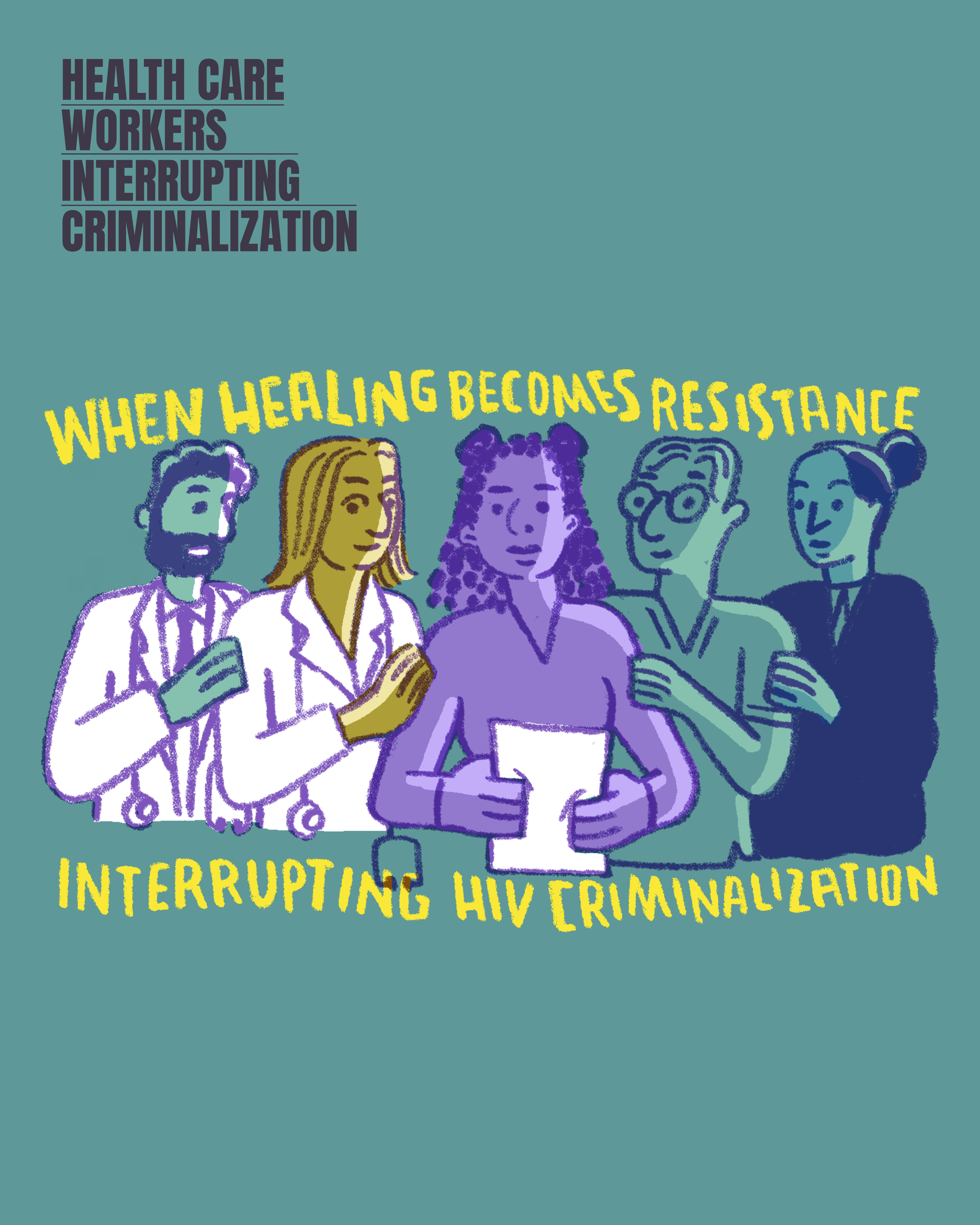
A Zine and Audio Story
Storytellers: Lashanda Salinas, Tennessee Advocate - Health Not Prisons / Jada Hicks, Senior PJP Attorney - The Center for HIV Law and Policy
Zine Art and Design: Kruttika Susarla
In this story — offered in both zine and audio formats — an advocate and an attorney share an intimate story about the power of community and policy, and the role of health care providers in the movement to end HIV criminalization.
This story is part of the Beyond Do No Harm Network’s Storytelling Media Project, which seeks to highlight and amplify the actions individual medical providers are already taking to interrupt criminalization in the context of care, in the hopes of increasing awareness of the harmful impacts of criminalization within the medical system and inspiring others to take action at multiple levels.
Check out the zine, audio, and audio transcript below!
-
When Healing Becomes Resistance: Interrupting HIV Criminalization
[00:00:00] Lashanda: My name is Lashanda, and I'm an organizer and advocate based in Tennessee.
[00:00:12] Jada: My name is Jada, and I am an attorney at the Center for HIV Law and Policy. Lashanda and I work together as part of the Tennessee HIV Modernization Coalition to end the criminalization of HIV. Lashanda's story really changed my advocacy and how I approach this work.
[00:00:36] Lashanda: In 2006, I met a gentleman on the chat line and we were interested in each other. I proceeded to tell him that I was HIV positive, and we decided that we were going to be in a relationship. So we dated, and a couple of months later, I moved in with him. After a while, the relationship wasn't working out, and we both decided to split up.
[00:01:01] I thought everything was okay, until I was at work one night and two police officers walked into my job asking to speak with Lashanda Salinas. I stated, "I'm her. How may I help you?" They told me they had a warrant for my arrest. Why would they want to arrest me? They said, "Your ex stated that you did not tell him that you are HIV positive, and he has pressed charges against you."
[00:01:27] I told them that he was wrong. I knew I had told my ex I was positive, and only after that did we agree to date. The officer said he would have to arrest me. I called my boss and explained to her what happened, that I was going to jail. So she gave me instructions to get someone to cover until she could get there.
[00:01:50] I was handcuffed and placed in the back of the police car. At that moment, it still had not set in that I was on my way to jail. I had some money on me, so I guess I was thinking, okay, I can bail myself out, because I've never been in any real trouble before. I remember walking through the door of the jail and being put into what they called a holding cell. The holding cell looked just like a big dog cage.
[00:02:19] That night, the judge gave me a bond of a hundred thousand dollars. I was not about to call my mother, who was at the hospital with my dying father, who had brain cancer, and tell her to put up anything that she and dad had as collateral. Before I went to jail, I did get a chance to call my mom and let her know what happened.
[00:02:40] I finally got to my cell, and that is when it hit me. I was in jail, and I wasn't getting out. I was given a public defender, who told me the first thing she was going to do was to ask for a bond hearing to see if I could get my bond reduced to something lower, so I could try and get bailed out.
[00:03:01] The day of the hearing, I was so nervous. I thought I was going to pass out. It came time for me to take the witness stand. The prosecutors started asking me questions, like if I had family in Tennessee, and I told him I did because I wasn't about to lie. I told him that I had family in Nashville, Knoxville, and at the time, Chattanooga. The judge denied my bond because he believed I was a flight risk, that I could go to these cities and not return to court.
[00:03:32] When I got back to my cell, I cried myself to sleep. At that moment, I had thought about killing myself. So I sent a letter to the nurse to let them know how I was feeling, and the next thing I know, the corrections officer took me to another room and put me in handcuffs.
[00:03:50] Later that day, I received a letter from my public defender stating she is trying to hire an infectious disease doctor to come and speak on my behalf. So I was waiting for that to happen.
[00:04:02] I thought back to the day I found out about my status. At that time, I was 16, and I remember going to the mailbox and seeing a big envelope from American Red Cross. I thought, why are they sending me information? Did they want me to donate blood again? I opened it and the first thing I read was, "We could not use your blood because of HIV antibodies."
[00:04:29] At 16, you comprehend, but you also don't really. I flipped through the pages and all I saw was HIV. HIV. My heart just went to the bottom of my feet. I went straight to my family physician and showed her the paper, and she said, we're going to have you take an HIV test. A couple of weeks later, she called me and said to come into her office.
[00:04:56] I knew at that point something was wrong. When I got there, a lady from the health department walked in with her. I knew I was HIV positive, because why in the world would there be someone else there if nothing was wrong? She told me that she did seven tests, and all seven came back positive for HIV.
[00:05:19] The first thing that popped into my head was, I don't have long to live. At the time, all I knew was that HIV was a death sentence. You're going to die. It's just a matter of time. The lady from the health department did not give me any information about this. She just gave me a phone number for the comprehensive care center, and told me I need to set up an appointment to see one of the HIV doctors there.
[00:05:46] The next thing she said to me hurt me to my core. I would have to tell my mom. In the State of Tennessee, if you are under the age of 18, you have to tell your parents. How in the world do I put my mouth together to form the words to say, mom, I'm HIV positive.
[00:06:08] They called my mom upstairs. The first thing she said was, "Tootie, I already know you're pregnant." I said, "Mom, I really wish I was. It's something more devastating." I proceeded to tell her I was HIV positive. It was like the words knocked the wind out of her. I've never seen my mom cry like that. I thought I had let her down, but in that moment, she looked at me and said, "Tootie, everything's gonna be fine. We're gonna get through this together." From that day forward, my mom was at every doctor's appointment. She made sure I took my meds, and she made sure I ate. She was my biggest cheerleader.
[00:06:56] As a young person, it was shocking to learn about my positive status through a public health notice. After donating blood, I realized that the gentleman I had been with hadn't disclosed his status to me. Even after I found out I was positive, he still refused to disclose his status to me. I learned many years later that not only did he transmit to me, but he also transmitted to two of my best friends. Now, years later, it was devastating to be accused of the exact harm I had experienced at a young age, when I had been so careful to prevent this from happening.
[00:07:39] My ex claimed that he did not know I was HIV positive, that I didn't tell him, and the only way he found out was through my medication. He said he took the medication to the pharmacy, and that's when he found out that I was HIV positive. From there, he filed charges. But I know that he knew I was positive. He had seen me take my medicine every day we were together. It was on the dresser we shared while we were in a relationship. He even picked it up for me from the pharmacy. So how could he say I didn't tell him?
[00:08:15] When I went back to court, they gave me two options. Go to trial and potentially spend three years in a woman's prison, or plead guilty and spend a year and a half in prison and a year and a half on probation.
[00:08:29] The next morning, I got a very upsetting call that my father had died. At that point, I didn't even care about anything anymore. I had decided to meet with my case manager to find out how I can at least view my father. She had given me instructions on what I needed to do: get in touch with the funeral home and have them send a letter on company letterhead with information about my father's arrangements, so I could be granted a furlough.
[00:08:57] My case manager sent over all the information to my public defender so she could request a court date. One morning, I was having breakfast and my name was called for court. Some of the ladies had told me that I was probably going to get my furlough, so I got ready and waited for them to call me. My public defender proceeds to tell me that my furlough had been granted, but she has another offer that she thinks I would like.
[00:09:25] She tells me that the offer is: plead guilty to the charges and be sentenced to three years' probation. I had to think about this one for a moment, because if I agreed, I would have to say I was pleading guilty of what they charged me with. I did not want to do that because I knew that I had told my ex that I was HIV positive.
[00:09:49] Then I began to think that if I took this plea, I would get out in time for my father's funeral and be able to help my mother, and she wouldn't have to worry about me. My mother is my life, and I knew she was going to need me, so I decided to take the three years' probation. So I went into court and told my judge that I plead guilty to criminal exposure to HIV.
[00:10:15] What the judge and the public defender did not tell me was that this meant I would be required to register as a sex offender for the rest of my life.
[00:10:30] Jada: When I think about Tennessee's HIV law, I don't just think about the legal language. I think about the people. The lives that have been turned upside down. In Tennessee, if you are living with HIV and know your status, you can be convicted of a charge called criminal exposure to HIV. What it means is if you have any kind of intimate contact with another person, and you don't disclose your status first, you can be charged with a felony. Even if HIV is not transmitted. Even if transmission isn't even possible. A Class C felony.
[00:11:09] In these cases, they often come down to one person's word against another. Before 2023, under Tennessee's old law, criminal exposure to HIV was considered a violent sexual offense. Just think about that for a moment. Those words alone carry so much weight, so much stigma. If you were convicted of criminal exposure to HIV, you'd have to register as a sex offender for life.
[00:11:42] And the punishment doesn't end there. Being on the registry has so many other consequences that change the course of your life. It leads to the release of personal information to the general public. Imagine: your name, picture, even your address, all public and searchable online. It's not only deeply stigmatizing, but potentially puts you at risk of harm. Being on the registry means living under constant surveillance and restriction. You can't just live or work anywhere, or even travel freely, without checking a long list of rules. One slipup and you could be facing a new criminal charge.
[00:12:26] It's a system that doesn't just punish. It isolates. People lose their jobs, their homes, their communities. Many may have to rely on underground economies just to survive. Paying fees to stay on a registry that they should have never been on in the first place. It's a cycle. It increases their likelihood of being arrested again, and keeps people trapped in fear and poverty.
[00:12:54] Lashanda: I was on probation in Nashville, Tennessee, and I decided to change to the probation officer in Hartsville, Tennessee, because that's where I'm from. The probation officer in Nashville did not tell me at any time that I had to register as a sex offender. I only found out when I transferred my probation to Hartsville.
[00:13:14] I was at work one day, and got a call from my PO who told me that I had 24 hours to go to Cookeville, Tennessee and register as a sex offender. I told her, "You have the wrong person, because I've never done anything to a child." She told me that I was charged with criminal exposure to HIV, and that requires me to register as a sex offender. At my first appointment with my probation officer, she tells me the rules of being a sex offender.
[00:13:48] Jada: In Tennessee, people on the sex offense registry are required to register with the Tennessee Bureau of Investigation or TBI, providing personal information and updating it regularly. They also face residential and employment restrictions, particularly near schools and child-related facilities. People on the sex offense registry must register with the TBI within 48 hours of their release from prison, and keep reporting to the bureau every single year, unless they're categorized as violent sexual offenders, in which case they have to report every quarter.
[00:14:24] They also have to report any changes to their address, phone number, email, social media accounts, employment, or vehicle within 48 hours. Failing to register or report required information is a Class E felony, and can result in a $350 fine and a 90-day prison sentence. People on the registry are barred from living or working within a thousand feet of schools, childcare, facilities, parks, and other places where children gather, and can be placed on additional restrictions around where they can go, what they can do, and who they can see.
[00:15:03] Lashanda: As my probation officer was telling me all of this, I was in complete shock. I asked her, "So are you telling me I basically cannot be around my family because there are kids?" She told me that is true, and because this was considered a sex crime, I must follow the sex offender rules and guidelines. At that moment, I cried.
[00:15:27] I had always been there for my little cousins, been at holiday dinners, and was able to go to church. I had to follow these rules for the rest of my life. Do you know how hard that is? For 17 years, I had to abide by these rules, which meant I couldn't go to church. With the help of my pastor, who talked to my probation officer, I could be under his care when I went to church. But I couldn't be around my cousins or family. No Christmases, no Thanksgivings, Easters, or any other holidays.
[00:16:09] Jada: But in 2023, the law changed, offering a new hope for people living with HIV, like Lashanda, who spent years forced onto the state's sex offense registry. That change meant a spark of hope. For the first time, some people might be able to finally come off the registry, some who'd been on there for decades.
[00:16:32] Imagine the relief you would feel. But here's the thing though - no one was planning to tell them. That's where we stepped in. At the center for HIV Law and Policy, we learned that the Tennessee Bureau of Investigation wasn't going to notify anyone that they might finally have a path off the registry. So we got to work.
[00:16:53] We teamed up with the Vanderbilt Law School Legal Clinic. With guidance from community members, we decided to send a simple, clear letter to nearly 80 people who were on the registry only because of an HIV related conviction. Our letter explained the change in the law, laid out the steps they could take, and even included a template letter that they could use to contact the bureau directly to request removal.
[00:17:17] But we didn't stop there. Because changing a law doesn't automatically change a life. People need to know. They have to be told. They have to be supported. That's why we work closely with health care providers who are often the first people patients turn to for guidance. Providers can support this work by sharing clear, accurate information about the law, connecting patients to legal resources like CHLP and the Vanderbilt Law School Legal Clinic, and offering the practical and emotional support people need to navigate the process.
[00:17:52] By partnering with providers, we turn legal change into real life relief. To amplify that awareness and community power, we organized Changing Laws, Changing Lives, a public event to share the news about the change in the law, answer questions, and honor Lashanda's removal from the registry. The room was filled with an incredible mix of joy, tears of relief, and celebration. It was a moment of true community triumph - one we will never forget.
[00:18:26] Today, there are 60 fewer people on Tennessee's registry as a result. 60 fewer people who have to carry that weight. At CHLP, we're committed to making sure our communities are informed, uplifted, and never left behind.
[00:18:44] This work is about more than a law. It's part of a broader movement. Our people refuse to let unjust laws define who they are, and we'll keep fighting every day to change them.
[00:19:00] Lashanda: On July 7th, 2023, once I filed the request, I was successfully removed from the registry. My life did a 360. For the first time in 17 years, I was finally able to see all of my family. When I look back on that time, I wish somebody, a healthcare provider, a public health worker, or a counselor, would've told me how to protect myself from someone bringing a criminal charge against me.
[00:19:31] As an HIV positive person who disclosed my status and the relationship I was in, nobody ever told me what disclosure was, and how I would be able to prove it. All of my HIV doctors have been such amazing people and a blessing in my life, but I wish someone had said to me, "Be careful. There is a law out there. Maybe try to bring your new partner to a doctor's appointment, so they can understand everything clearly and get some documentation to keep yourself protected before you are intimate with someone." If I'd been told what to do to protect myself when I was first diagnosed, I don't think I would have ever been in this situation.
[00:20:16] Health care providers can also support legislative efforts to repeal unjust laws that impact people who live with HIV. There's been a little bit of change that helped some of us remove our names from the registry, but there's still a lot of work to do. That's why me and my fellow advocates are continuing to fight to repeal these unjust laws in Tennessee and worldwide.
-
Can you think of a policy that's framed as promoting public health and safety, but that might, in practice, increase punishment, surveillance, or exposure to harm for people living with HIV?
How do you think this story challenges the idea that responsibility or risk belongs to a single individual?
What is one way you can imagine putting the principles of harm reduction into practice through policy or legislative advocacy?
-
Kruttika Susarla is an illustrator and cartoonist working with community-engaged organizations in the Global South and the U.S. to create books, zines, and toolkits. Learn more about Kruttika and explore her work here.