BDNH Storytelling Project: Listening, Resisting, Healing: HRNA's Fight Against Recriminalization in British Columbia
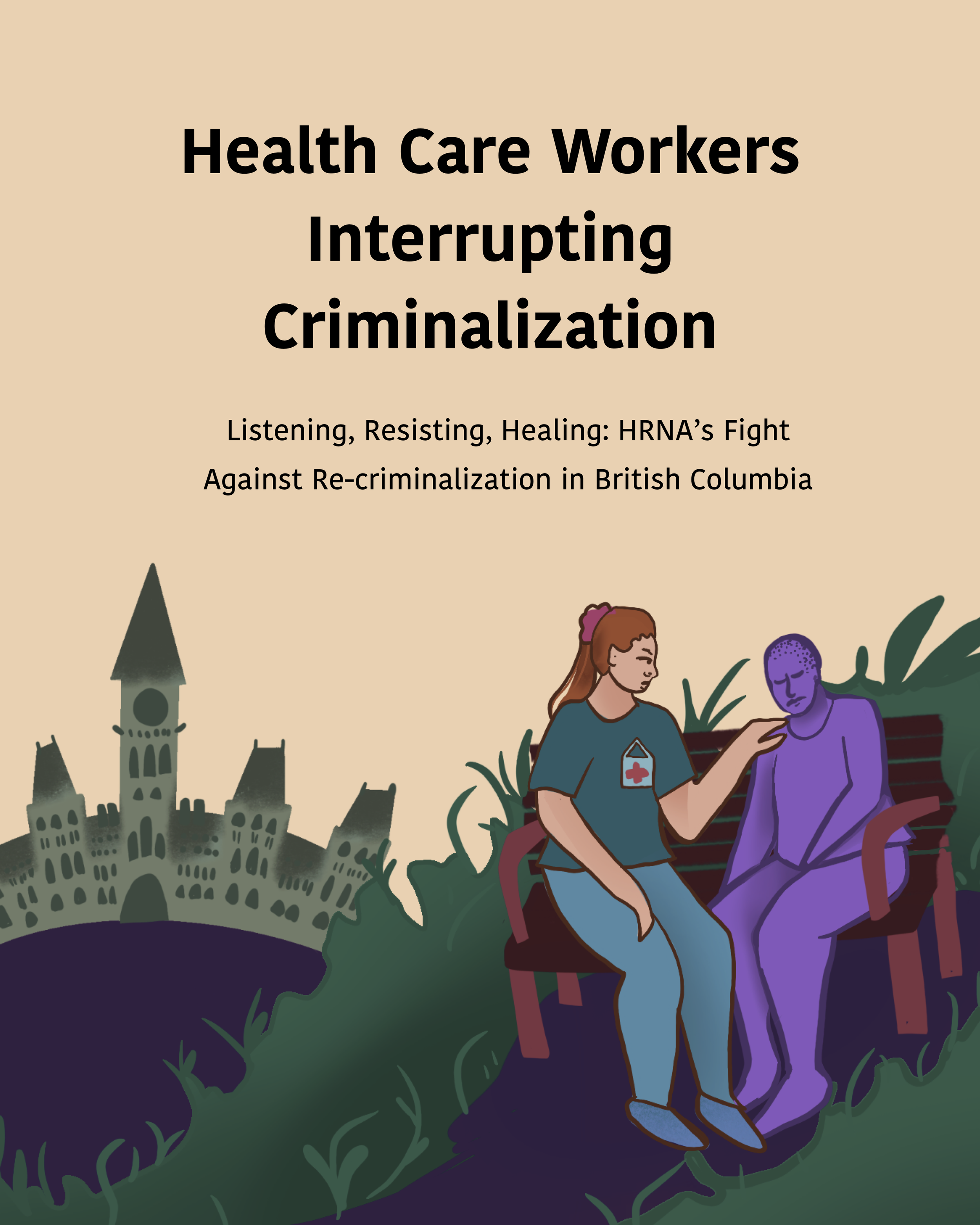
A Zine and Audio Story
Storyteller: Corey Ranger, Registered Nurse, President - Harm Reduction Nurses Association
Zine Art and Design: Amir Khadar
In this story — offered in both zine and audio formats — a harm reduction nurse in Canada leads his community in a fight against Bill 34, which would re-criminalize public drug use.
This story is part of the Beyond Do No Harm Network’s Storytelling Media Project, which seeks to highlight and amplify the actions individual medical providers are already taking to interrupt criminalization in the context of care, in the hopes of increasing awareness of the harmful impacts of criminalization within the medical system and inspiring others to take action at multiple levels.
Check out the zine, audio, and audio transcript below!
-
Listening, Resisting, Healing: HRNA's Fight Against Recriminalization in British Columbia
[00:00:00] My name is Corey. I'm a registered nurse and president of the Harm Reduction Nurses Association.
[00:00:15] For the past 14 years, my practice has taken me from operating rooms to acute care, to public health and community outreach. But one truth has always remained constant: injustice, inequity, and state violence shape people's health. And nurses — we're uniquely positioned to respond — not just with compassionate evidence-based care, but also by standing up for justice, equity, and systemic change.
[00:00:43] That's the heart of HRNA's mission, and that's why we take a strong stand against harmful laws and policies like Bill 34. When Bill 34 was introduced in British Columbia, it sent shockwaves through communities already grappling with the deadly consequences of a poisoned drug supply. It was framed as a public safety measure, but in reality, it would've criminalized visible drug use in nearly every public space, forcing people further into the shadows, further from lifesaving supports.
[00:01:17] As nurses on the front lines, we couldn't stay silent. Remember, BC's toxic drug crisis has been a public health emergency since 2016, and it has already claimed more than 17,000 lives. In emergency departments, in community clinics, in supervised consumption sites, every day we see the truth: drug use isn't a threat to be policed. It's a health issue. One that must be met with compassion, evidence, and care. We support people after overdoses. We help them navigate the barriers the system puts in their way, and we witness daily the toll of homelessness, poverty, and criminalization. That's why we felt the responsibility, not just as healthcare professionals but as allies.
[00:02:05] We challenged Bill 34 in court alongside partners like the Canadian Drug Policy Coalition and PIVOT Legal Society. And before — and throughout — we listened. We listened to people who use drugs, to unhoused communities, to Indigenous leaders. We saw important statements from the Surrey Union of Drug Users and the Union of British Columbia Indian Chiefs, who denounced the bill.
[00:02:29] Listening told us what this bill really meant:
[00:02:33] It would push people further into unsafe hidden environments because they had nowhere else to go. Their voices guided our decision. And for us, going to court wasn't just legal strategy —it was nursing. Advocacy rooted in the values of our profession. All of this played out against the backdrop of BC's decriminalization pilot.
[00:02:56] Introduced in early 2023, it was meant to remove criminal penalties for small amounts of drugs — recognizing substance use as a health issue, not a crime. With real resources, it could have been a turning point— safer spaces, housing, treatment, a regulated drug supply. But instead, it rolled out with the bare minimum. Homelessness, poverty, and the poison drug supply remained untouched.
[00:03:25] So the policy was set up to fail. People continued to use in public, often just to stay safe in case of overdose, while the public misread it as disorder. Without addressing root causes, the promise of decriminalization stayed symbolic. And then came Bill 34. The government claimed it would encourage people to use safer spaces, but here's the reality: most communities don't have them.
[00:03:53] So this wasn't about safety, it was about panic, about manufacturing consent to keep punishing those most at risk. And taking the stand came with a cost. Nurses on our team faced hate mail, media attacks, political blame. Sometimes we had to shut down our own contact page just to cope. But we leaned on one another.
[00:04:15] We reflected constantly on the system we were trying to build, and that collective care — that solidarity — kept us going. When the BC Supreme Court granted an injunction against Bill 34, it was called a "People's Victory." The chief Justice recognized that the bill risked causing irreparable harm to people who use drugs — especially those unhoused.
[00:04:38] The court also named the deeper truth:
[00:04:40] "The unregulated nature of the illegal drug supplies the predominant cause of increasing death rates in British Columbia."
[00:04:47] This wasn't just a legal win; it was validation. Proof of what harm reduction advocates have known for decades: that criminalization doesn't save lives. Compassion does.
[00:04:59] Yes, the province has since tried new ways to recriminalize. The fight continues, but the victory was never only in the courtroom. It was in showing up, standing up with our patients, witnessing their courage, affirming that their health and dignity matter. And now the work carries on through judicial review, through advocacy, through collective resistance. Like runners in a relay, we pass the baton, sharing the burden, sharing the strength.
[00:05:31] As nurses, as healthcare workers, we see the devastating impact of criminalization every day. But we also see resilience. And so we hold cautious hope, because every small act of care matters. Every moment of advocacy matters. Every single life matters. The road ahead is difficult, but our commitment to listening, resisting, and advocating alongside our patients will carry us forward, because health justice demands it, and because every life lost to the toxic drug supply is one too many.
-
Central to harm reduction is the belief and practice that no one is disposable — how do you see that politic reflected in this story?
What is one way you can imagine putting the principles of harm reduction into practice through policy or legislative advocacy?
What is one way you have experienced or contributed to an act of collective care?
-
Amir Khadar (they/them) is a Sierra Leonean-American multidisciplinary artist, designer, and educator originally from Minneapolis, MN. Their work as an illustrator and designer engages art as a powerful liberatory force, creating visual language for social change movements centered on decolonization, de-carceration, and environmentalism. Amir’s commitment to justice is evident through collaborations with organizations such as Thousand Currents, multiple ACLU chapters, Initiative Sankofa Afrique D’Ouest, and Forward Together. Their practice spans posters, reports, book design, art installations, exhibitions, and educational projects that imagine new ways of being for their communities. Amir also explores these themes through textile and digital art, integrating their storytelling into weavings, drawings, beadwork, and quilts. Learn more about Amir and their work here.