BDNH Storytelling Project: Is it a Rule or is it a Law?
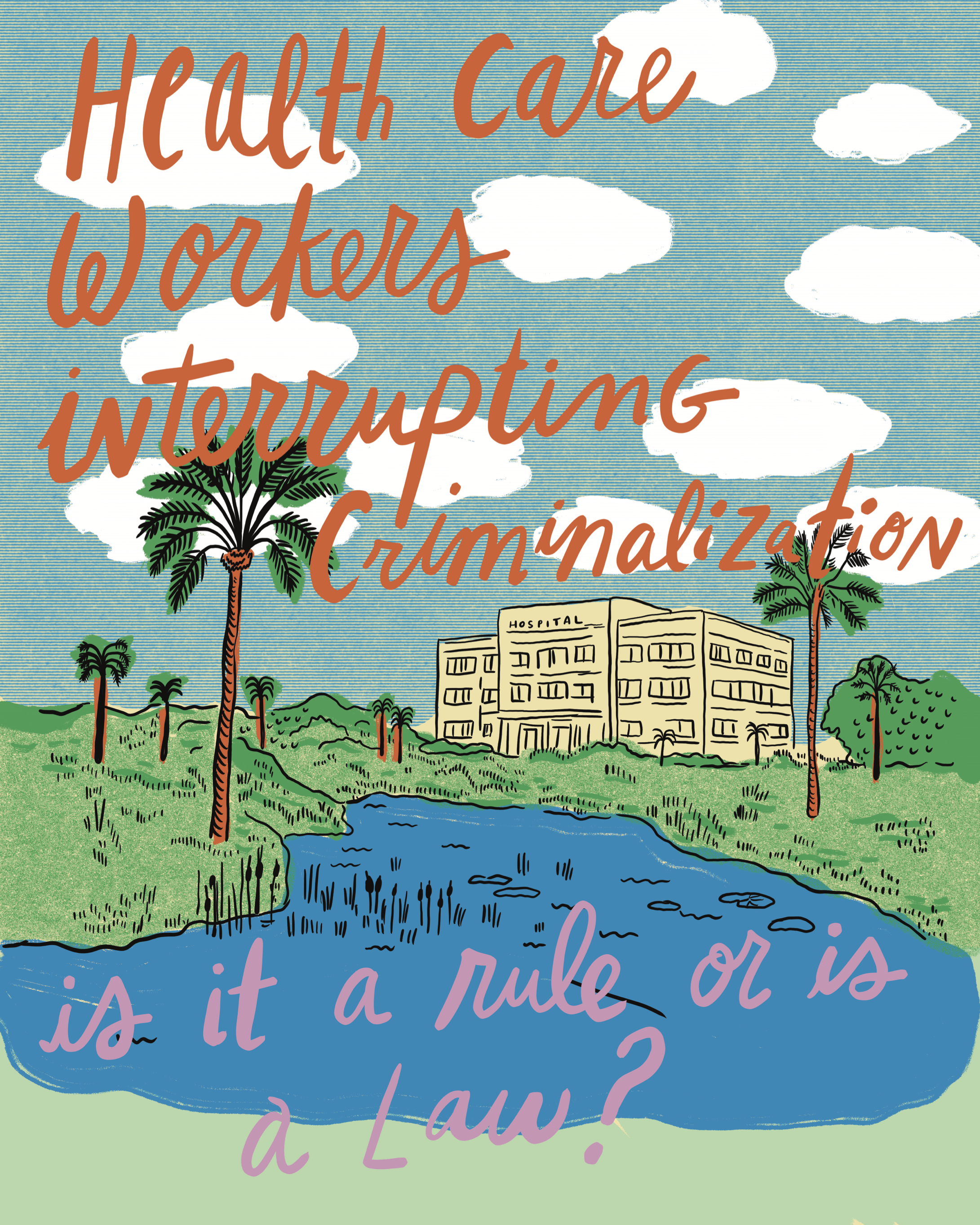
A Zine and Audio Story
Storyteller: Resident Physician, Florida
Zine Art and Design: Lena Kassicieh
In this story — offered in both zine and audio formats — a resident physician in Florida discusses the importance of pushing back against cruel rules and policies in hospitals that impact care for incarcerated patients.
This story is part of the Beyond Do No Harm Network’s Storytelling Media Project, which seeks to highlight and amplify the actions individual medical providers are already taking to interrupt criminalization in the context of care, in the hopes of increasing awareness of the harmful impacts of criminalization within the medical system and inspiring others to take action at multiple levels.
Check out the zine, audio, and audio transcript below!
-
Is it a Rule or is it a Law?
[00:00:00] The first day of my first month of my first year of residency, I walked into a patient's room. My senior resident had sent me to check on the urgency of the patient's condition to decide whether we needed to call another team to get them a procedure quickly. Guards from the local Florida Corrections Department were sitting outside, and the patient was chained to the bed.
[00:00:31] As I was taught to by organizers during medical school, I asked the guards to release the patient from the chains while I examined them, but the guards told me that it was against policy. I didn't fight back. I wondered, Is it a rule or is it a law, and what is my responsibility regardless?
[00:00:51] The next day, when I went back to see the patient, they opened up about the hopes they had for after their release from prison. I explained to them how their medical condition could be treated once they were back home, and how to access care. They told me they hadn't seen a doctor in years, and I offered to be their doctor on the outside.
[00:01:11] At some point, they asked me how long I'd been a doctor, and when I told them it was my first week, they laughed, and they told me they thought that made sense. That I was still in a place where I would actually listen.
[00:01:24] In order to provide them with information about the specialty care they would need going forward and the health maintenance screenings and exams they required, I wrote up a packet for them. I included a card with my email address telling them that in a few months, they could reach out, and I would work with them to treat their condition. When I gave the patient the packet, the guard looked at me and laughed. They took it from me, tucked it next to their lunch, and said they would have to give it to the corrections medical officer.
[00:01:55] When I asked why the patient couldn't keep it, they told me people under corrections are not allowed to have physical papers given to them. I asked my boss on the team where that rule came from, and they said they didn't know. That afternoon, I went back to check on this patient and tried to slip them just my tiny business card. The guards didn't notice while I was in there, but I'm sure they did later. I never got an email.
[00:02:23] Months later, we received a text from our program leadership telling us that we were to stop reaching out to the families of incarcerated patients with updates. This came after multiple experiences, taking care of people in the emergency room, the ICU, the hospital, and even the children's hospital, all of whom were experiencing the impacts of incarceration.
[00:02:47] In response to the text, I asked, Is this a rule or is it a law? And heard back that it was technically the policy of our specific hospital, but the program leadership had yet to see it in writing. I'm still waiting for an answer to that question. Is it a rule or is it a law?
[00:03:07] As a resident, I'm trying to carve out ways to act in line with my values in a system with opaque, sometimes baseless, and often harmful guidelines for how we interact with patients impacted by the carceral system.
[00:03:24] Later in the year, I was rotating through the ICU, and I decided to shift my focus from trying to impress my team members with medical knowledge to instead taking my time to sit with families and help them understand what was happening to their loved ones.
[00:03:40] I ended up working with a family of a patient who was impacted by carceral systems in a different way. I wasn't caring for someone being incarcerated by the system, but for someone who moved across the world and was working as a contractor for the carceral system. In this particular situation, I was the main contact for the patient's family. They lived across the world and feared for their loved one whose health was being adversely impacted - not because they were a detainee of an oppressive carceral facility, but because they worked there.
[00:04:12] The patient's immigration status and the lack of resources available near the facility contributed to the widening gap between their health and the care they needed. The family met me with such grace when I suggested they come to see their loved one, fearing it could have been his last days, and told me that obtaining visas would be next to impossible.
[00:04:34] I attempted to advocate, and wrote a letter to expedite their visas. I'm not sure the letter was ever sent, but I was relieved to learn months later that this person's spouse did make it to the United States, and that the patient survived.
[00:04:53] All of this happened just outside my hometown in Florida, where just a few months later, the state government partnered with the new administration to build an ICE detention facility in just eight days, with greater capacity than any of us anticipated. It also happened next to the infamous Krome Detention Facility, where multiple people have died due to delayed necessary medical care.
[00:05:18] My patient, who left his home to provide labor to a place where people are incarcerated under harsh and horrible conditions, suffered due to the inhumanity of a system that is just continuing to grow.
[00:05:35] I know I'm not the only one asking these questions. Many providers who are receiving patients in ICE custody are being told they can't connect patients with family or give them access to phone calls.
[00:05:46] As we continue to raise these questions, we need to find ways to align values around patient care with action in this particular context. Whether these conditions are propped up by hospital rules or legislative policies, I will continue to use my privilege as a physician, even a physician in training, to push back against rules and policies, and the things people say are rules without offering any proof, that interfere with my ability to provide care.
[00:06:17] I hope that the small interruptions and questions I raise can lead others to call into question our system and bring better care to those we encounter in big and small ways.
-
What is one way that the narrator listened closely for a need and took action?
What is a harmful rule or policy you can call into question?
How would you do it, and who could you do it with?
-
Lena Kassicieh is a Palestinian multidisciplinary artist and anthropologist whose work focuses on key themes of nostalgia, identity development, diaspora community, and folklore. Learn more about Lena and explore her work here.