BDNH Storytelling Project: The Right to Dignity: Securing Compassionate Release for Incarcerated People
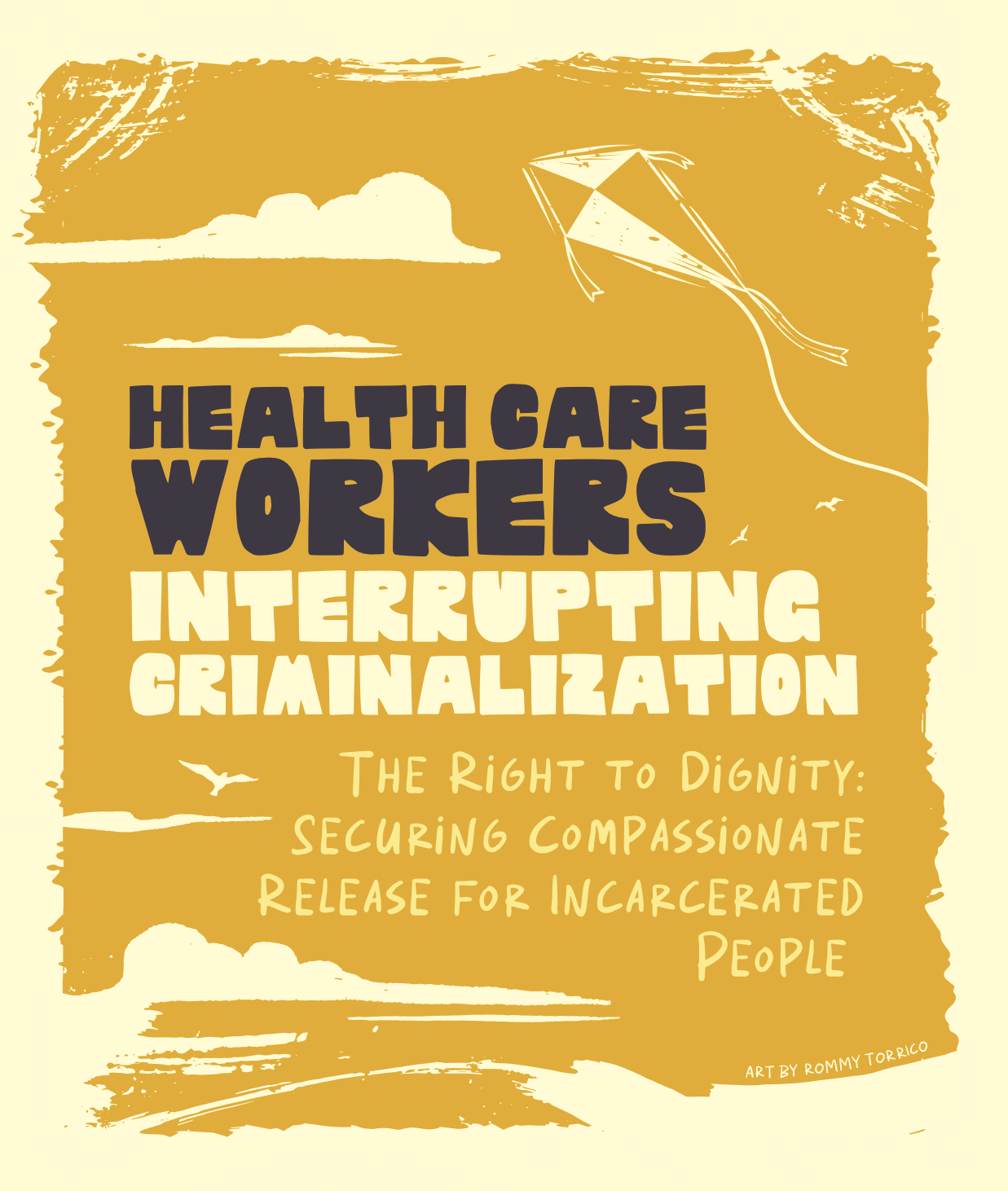
A Zine and Audio Story
Storyteller: Internal Medicine Physician, Georgia
Zine Art and Design: Rommy Torrico
In this story — offered in both zine and audio formats — a physician in Georgia utilizes compassionate release as a strategy to advance care for in-custody patients
This story is part of the Beyond Do No Harm Network’s Storytelling Media Project, which seeks to highlight and amplify the actions individual medical providers are already taking to interrupt criminalization in the context of care, in the hopes of increasing awareness of the harmful impacts of criminalization within the medical system and inspiring others to take action at multiple levels.
Check out the zine, audio, and audio transcript below!
-
The Right to Dignity: Securing Compassionate Release for Incarcerated People
[00:00:00] My name is Mark Spencer, and I am a researcher, educator, and internal medicine physician who works in Atlanta, Georgia. I'm the executive director of Stop Criminalization Of Our Patients, or SCOOP, where we work to politically educate and organize health workers to support local efforts in reducing criminalization and incarceration. Through our work, we've seen how poor transparency is a defining feature of jails, prisons, and detention centers.
[00:00:34] As a clinician at a community hospital, I see many patients who are admitted from various carceral facilities. As an "in-custody patient" in the hospital, many medical and legal rights are ignored by both security and medical staff.
[00:00:48] The uncertainty of what hospital staff can do or say when caring for in-custody patients, whether advocating for privacy, removal of shackles, or improving care at the jail or prison they came from, creates significant moral distress. One way health care workers should view these moments is as an opportunity to see into a system devoid of transparency.
[00:01:10] We bear witness to the often inadequate and negligent "care" these patients receive, or too often don't receive, in carceral facilities. So much preventable harm occurs in carceral settings that goes unaddressed or unacknowledged.
[00:01:25] One way to mitigate these harms is to always consider supporting medical release. What does this mean and how might it work in practice? It is relatively straightforward, requires no legal expertise, and simply requires that when you feel that moral distress, you pause and ask yourself, What can we do for this patient?
[00:01:46] I would like to share two stories to illustrate two ways we might think about medical release, or what is sometimes called compassionate release, or medical reprieve.
[00:01:56] My first patient was in his fifties and came from a local jail. He had been incarcerated for almost 12 months. For most of his adult life, he struggled with alcohol use, which resulted in cirrhosis of his liver. He had also cycled in and out of local jail systems for years. When he arrived at the hospital, he had lost a lot of weight and was so weak he could not stand without support.
[00:02:18] That day, we diagnosed him with liver cancer. It had spread throughout his body and there was no treatment available to him. This was a moment where we paused as a team. We knew that this patient was seriously ill and was likely going to die in the near future. We saw him each morning, shackled to his hospital bed, and knew that medical release was the only outcome that could hold some semblance of justice.
[00:02:42] By writing a letter summarizing his medical condition, functional abilities, and prognosis, we were able to get his charges dropped. He died in the hospital a few weeks later, free from guards, free from shackles. We couldn't reverse all of the trauma and neglect he had experienced over his lifetime. But we could value him as a human being deserving of dignity at the end of his life.
[00:03:07] A second patient was admitted to the hospital with diabetic ketoacidosis and active psychosis. He had been in jail for eight months. After treating his diabetes, it was clear that the patient required significant psychiatric support. However, his in-custody status kept a guard at his bedside, shackles on his wrist and ankle, and left no option for support from family or friends. It was a far cry from a therapeutic environment.
[00:03:35] Typically, once the immediate medical emergency is addressed, a patient is sent back to jail. Through our community work and research, we knew returning this patient to jail would be very dangerous, and that the hospital could offer an environment far more conducive to care. We wrote a letter explaining the severity of his condition and that it would likely be made worse in jail. Thankfully, our advocacy was successful, and he was released from custody to receive psychiatric care in the hospital.
[00:04:04] In both instances, all it took was an acknowledgement that the carceral system was not a place where they could receive the care they needed. As the first patient's story demonstrates, we should advocate for the medical release of every patient who is nearing the end of their life. In the second case, the patient required complex medical care. We should support medical releases in these situations, too, when a jail or prison is unable or unwilling to provide the care needed. Our patient required advanced psychiatric support. In other cases, a patient may require specialized nursing care, complex treatments, or expensive medications.
[00:04:44] Of course, this will not always be successful, but it is always worth trying. You are likely to find more success when advocating for patients who come from your local jails, rather than prisons or detention centers. The majority of these patients are being held pretrial and have not been convicted. By presenting a clear objective case of the severity of a patient's medical circumstances, they're often inclined to support release.
[00:05:12] If a patient is coming from a state or federal prison, the largest barrier is their post-conviction status. The criminal legal system's obsession with punishment often means it focuses on a patient's initial charges in discussions of medical release, regardless of how long ago they might have occurred.
[00:05:30] In both cases I describe here, the patient was incarcerated in a local jail. We did not need legal assistance to advocate on their behalf, although their legal representative, often a public defender, can be helpful in getting concerns to the right people. This is another benefit to seeking medical release from someone incarcerated in a jail, as most will have a lawyer. When seeking medical release from a prison or detention center, guidelines are much stricter, and obtaining legal aid through a partner organization can make a huge difference.
[00:06:01] Whether you are a medical student, resident, nurse, or any other member of a care team, you can initiate these conversations by expressing your concerns about a patient returning to a carceral facility. These cases show that there are tangible, scalable ways we as providers can push back against the carceral system.
[00:06:22] They also illuminate the hypocrisy that exists in our hospitals. Despite the stated values of health systems, these patients are so often sent back to the very prisons and jails that neglected their medical needs to begin with.
[00:06:35] Everyone deserves the best opportunity to heal. For those near the end of life, they deserve a death with dignity, free from shackles, guards, and with loved ones around whenever possible.
[00:06:48] Through involvement in medical release, more health workers will also come to question the utility of carceral systems that claim devotion to public safety, but deliver anything but. This work can also spark criticism of how health systems defer to, and collaborate with, the criminal legal system.
[00:07:06] Medical release does not end the harms of prisons or jails, but can make a meaningful difference for some patients. Individual actions are not a substitute for structural policy change. We must be better individual advocates for in-custody patients, while also working to build power to shrink the criminal legal system's footprint.
[00:07:25] I know that it can feel isolating to work within institutions that too often don't share your values. This is one reason we do this work: so that future healthcare workers have a community to support them as they continue to fight for their patients.
-
What is one way that punishment shapes care for people who are incarcerated?
What is one way that punishment in care can be interrupted?
What is one way you can honor the dignity and humanity of someone in your care?
-
Rommy Torrico is a formerly undocumented, queer, trans nonbinary visual artist born in Iquique, Chile and raised in Florida. They have been involved in social movement spaces encompassing (im)migrant, queer and trans rights struggles for over a decade and infuse much of their work with personal experience and the stories their communities share. Over the years, Rommy’s work has been included in several publications and exhibited at the Getty Museum, the Smithsonian Museum, the Library of Congress and the Museo Nacional Centro de Arte Reina Sofía as well as many galleries and museums throughout the Americas and internationally. Learn more about Rommy here.