
Workshop: Criminalizing Survival
Join Project Nia founder Mariame Kaba for a presentation on the "Criminalizing Survival Curricula" made in conjunction with Survived & Punished. Criminalizing Survival includes curriculum units and activities that can be used for political education focused on the intersections between racialized gender-based violence and criminalization.

Workshop: Turning Towards Each Other
Jovida Ross and Weyam Ghadbian wrote the Turning Towards Each Other Conflict Workbook with the hopes of supporting people working towards social justice to build our collective conflict resilience and strengthen relationships, movements, and collective wellbeing.

Workshop: Two Sides of Justice Curriculum
In this session, we will explore the ‘Two Sides of Justice‘ curriculum by engaging in the activities and discussing how and where this curriculum could be implemented. We will discuss questions like: What is justice? How can we address violence in non-punitive ways? How do carceral systems impact people who cause harm and who have been harmed?

Workshop: Creating Community in Classrooms
What are the building blocks for sharing space and how can we use them to address our needs as learners and educators? In this session, we will use the resource "How to Share Space: Creating Community in Classrooms and Beyond" as a springboard to explore the opportunities presented by these changing norms and the challenges they bring.

Workshop: Restorative Justice Circles at Home
How can we use family Talking Circles to deepen our closest relationships with honest and open communication? What would it mean to intentionally create our own family values? We'll explore these questions and more using the new resource "Talking Circles At Home and Parenting Restoratively" by longtime Restorative Justice practitioner Jennifer Viets.

Workshop: Self-Accountability & Movement Building
Join us to explore the role self-accountability plays in building strong, sustainable movements. We'll discuss how self-accountability—that is accountability with and for ourselves—is essential in building accountable communities and the movements to sustain them.

Trans Women of Color at Work
In this moment of uprising in response to the multiple crises unfolding across the country and world—particularly police violence against black people—it is imperative that we continue to demand what keeps our communities safe. Trans women and femmes of color (TWOC) have been historically excluded from the formal 1 workforce and forced to rely on criminalized work for survival. Such economic violence leads to police targeting and incarceration. Organizing over the past five years has begun to open up economic opportunities for trans women and femmes of color. We won’t go back. This is the time to fight to maintain and surpass those gains.
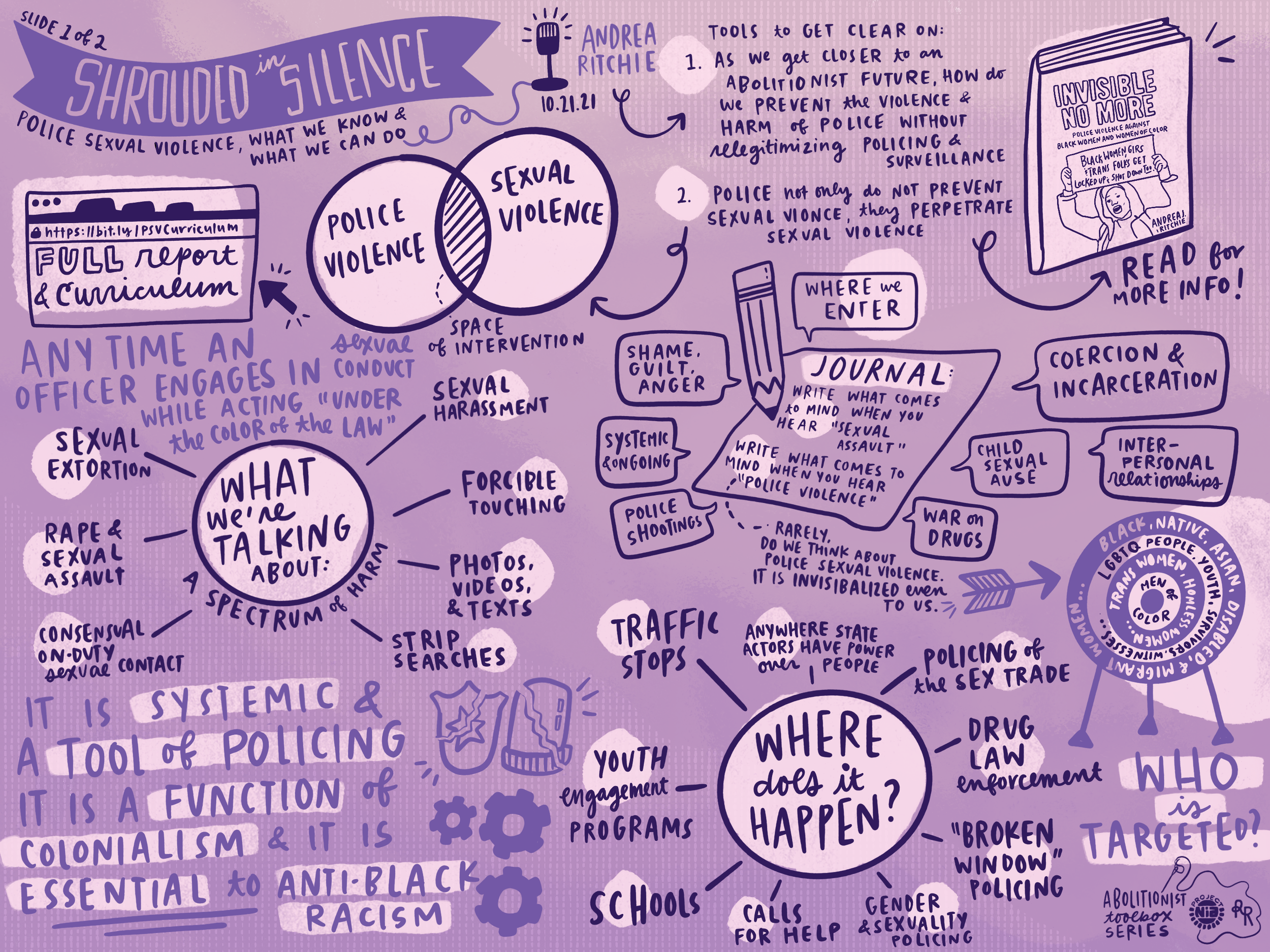
Workshop: Shrouded in Silence
In the midst of a national reckoning around the violence of policing, and a national conversation about sexual assault prompted by #MeToo and the ‘me, too.’ movement launched by Tarana Burke, sexual violence by law enforcement officers—including local and state police, ICE agents and Border Patrol, school “resource” officers, federal law enforcement agents, probation and parole officers—remains shrouded in silence. Survivors of police sexual violence are rarely heard from or discussed in either conversation, and their experiences generally do not drive organizing and advocacy in either context.