BDNH Storytelling Project: A Question is an Interruption
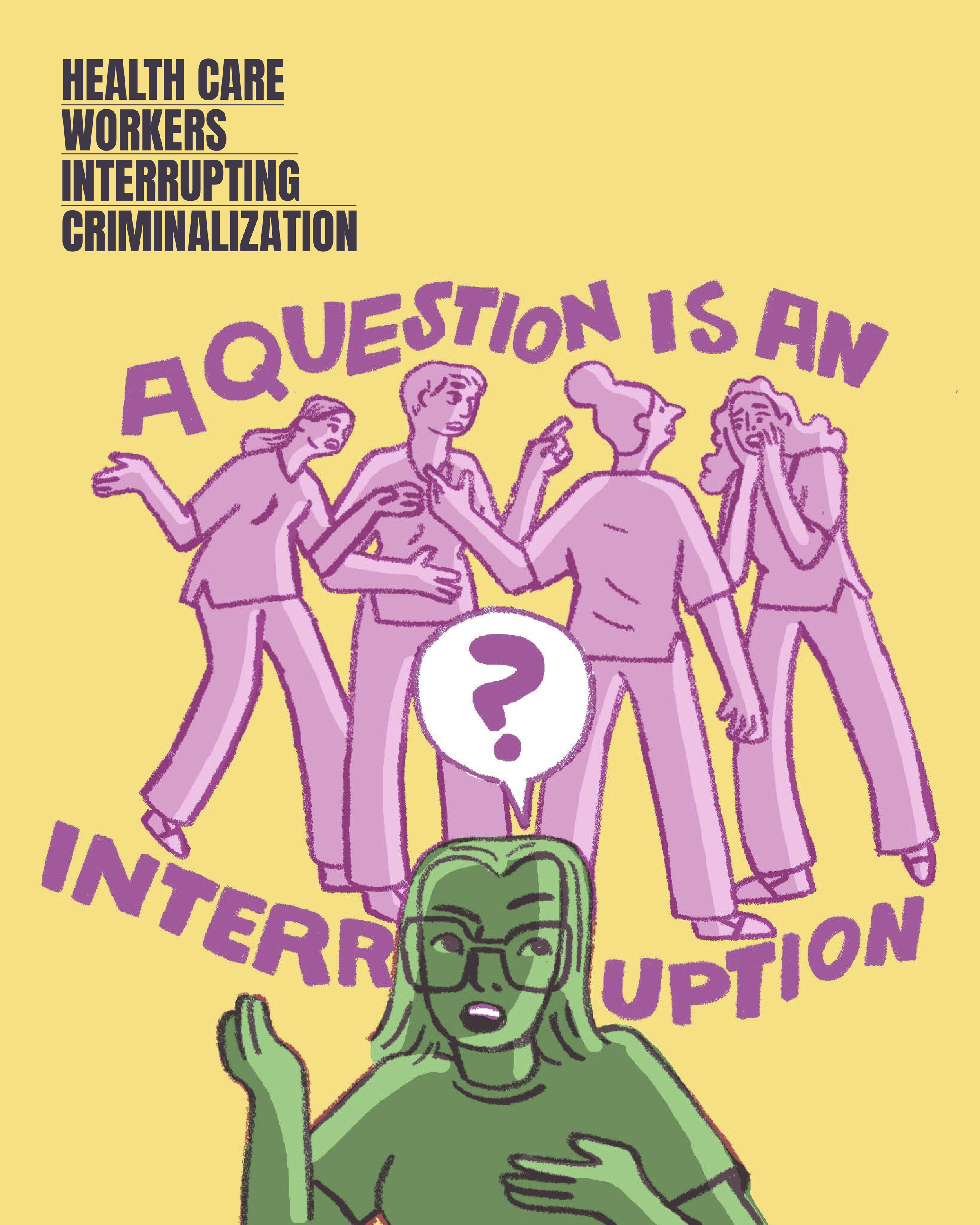
A Zine and Audio Story
Storyteller: 3rd Year Medical Student, California
Zine Art and Design: Kruttika Susarla
In this story — offered in both zine and audio formats — a medical student in California prevents security from being called on a patient's family member, emphasizing the importance of speaking up and asking questions.
This story is part of the Beyond Do No Harm Network’s Storytelling Media Project, which seeks to highlight and amplify the actions individual medical providers are already taking to interrupt criminalization in the context of care, in the hopes of increasing awareness of the harmful impacts of criminalization within the medical system and inspiring others to take action at multiple levels.
Check out the zine, audio, and audio transcript below!
-
A Question is an Interruption
[00:00:00] I was in high school when I first felt the threat of violence inside a hospital. I was a NICU volunteer for a month at my local hospital as part of my school's medical academy elective course. Most days were quiet— feeding premature babies, folding soft blankets, listening to the steady hum of monitors. But in my second week, during a late shift, the atmosphere changed.
[00:00:32] As I walked down the hallway, the sharp slap of sandals on the linoleum echoed ahead of me. A middle-aged Punjabi man in a tank top and sweatpants paced restlessly, his turban half-tied and slipping loose. His voice, rapid and urgently speaking Punjabi, poured into the corridor, distressed. His worried tone gave me a pause, but only briefly, before I hurried inside to start my shift.
[00:01:01] As I walked in, there was a hushed conversation in the NICU as I checked in, nurses' heads huddled together, with the doors closed, blue lights glowing. The atmosphere was tense compared to the usual banter I was familiar with, as the nursing staff discussed something in low voices. I could make out the words "knife" and "police," and things reached a fever pitch when a nurse called out, "What if he kills her?" That definitely got my attention.
[00:01:31] Me, being a curious teenager, asked the nurses, "What's going on?" They then began to tell me that they were debating whether or not to call police or security on a new dad. They said his baby girl was born with poor health and that he was upset and yelling on the phone in another language. But still, my confusion remained. Why did they wanna call the police on him?
[00:01:53] The nurses couldn't give me a straight answer. One explained that he had a knife. The other said his daughter was very sick. And the third drew the conclusion that since she was a girl, and very sick, and he apparently had a knife, that this was grounds for calling security.
[00:02:08] So I asked, "What knife?" A nurse replied with, "It's the huge one on his hip." Suddenly, it clicked. The object that they were assuming was a knife was actually his kirpan. In Sikhism. The kirpan is a symbol of one of the religion's principles: to stand up for the weak and for what is right. Being Punjabi and Mexican, I was raised both Sikh and Catholic, so I tried to explain the kirpan's significance the best way I could.
[00:02:38] "That's not a knife!" I said. "It's a religious ornament, and it's called a kirpan. A kirpan is kinda like a rosary. You wouldn't ask someone to remove a rosary, right? Did anyone ask him about it?" I was met with blank stares and silence. I was shocked.
[00:02:56] I grew up in Bakersfield, one of the largest Punjabi communities in California, and in the US, with 40,000 Punjabi residents. I couldn't believe that this could be happening in my own community— that the situation was so quick to escalate, and that because the nurses couldn't understand him, they felt they could jump to these outrageous conclusions. Thankfully, our conversation was enough to deter the nurses from calling security or the police.
[00:03:23] I went home that day and shared the story with my parents, expecting to be met with disbelief and outrage. However, in response, my mom said, "Oh, something like that happened to your dad, too, when you and your sister were born. The nurses were the same back then."
[00:03:40] My twin sister and I were actually born just a few feet away from the NICU I was volunteering in. Back then, my father had come straight from work to our C-section delivery, still wearing his FedEx uniform. He proudly exclaimed to the staff about our mountain of hair, laughing and joking around with my mom and grandma about how he was going to send us off to India to make sure we learned Punjabi and got a good education.
[00:04:05] Two days later, while she was still in pain from her C-section, my mom got a visit from a social worker in the hospital asking if she felt that she or her children were in danger from her husband. A nurse had overheard and reported my father, interpreting his joke as if he would literally ship us off in a box to India.
[00:04:24] Even now, we aren't sure if it was just racism, or because he was wearing a FedEx uniform, or a bit of both, but she told the social worker that she and her kids were safe, and to get the hell out of her room. Later, she told her OB/GYN about what happened, and all she got was a small apology. However, there were no other structural changes made in the hospital that would've prevented this from happening again. If I hadn't told my mom about witnessing this new dad almost having the cops called on him, my mom might have never shared the story with me.
[00:04:57] Now, as a third-year medical student about to embark on rotations, I reflect on these experiences with shocking clarity. I don't know if I would've been as brave as my high school self if this happened to me now. Back then, I wasn't yet jaded by years spent in healthcare, forced to assimilate into the culture of medicine with its obedient hierarchies and emphasis on maintaining the status quo.
[00:05:23] Maybe because I wasn't yet mired in that culture, I was able to speak up. If trainees and providers were encouraged to advocate and to avoid making assumptions, we could prevent so much harm.
[00:05:36] Why are we scared of asking simple questions in medicine?
[00:05:39] Why are we taught to pathologize everything, but can't even question the ways we perpetuate structural violence?
[00:05:46] Why does our culture reward authority and control over humility and understanding?
[00:05:52] Why is a system built to escalate conflicts instead of preventing them?
[00:05:57] Asking a clarifying question could seem small, but like the kirpan, it's an act of resistance, and an act which can help us protect the vulnerable and choose what's right.
-
Can you imagine yourself taking action similar to the storyteller's?
What would stand in the way? What would make it more possible for you to do so?
Imagine a time you encountered police in your workplace — what support or information would have been helpful to you at the time? How would you respond differently now?
-
Kruttika Susarla is an illustrator and cartoonist working with community-engaged organizations in the Global South and the U.S. to create books, zines, and toolkits. Learn more about Kruttika and explore her work here.