November 11, 2026
Welcome to the November 2026 installment of "This Month in Criminalization," in which IC co-founder Andrea J. Ritchie and researcher Kelsey Kitzke share hot topics and current legislative and policy developments in criminalization, and point people to calls to action and relevant resources. You can find previous editions of this newsletter on our website here. If you prefer reading the email version of this newsletter, you can view it here.
In this edition of the newsletter, Andrea shares some reflections in the wake of the recent U.S. midterm elections. Read on to hear her thoughts on critical pitfalls to avoid, opportunities and places where we can take action and mitigate current harms, and some of the challenges ahead as we organize for the future that we all deserve. Additionally, we share a few key updates on the fight to resist anti-trans and anti-abortion measures, and ways to keep up action and pressure to stop the deadly merger and stop the genocide.
You can find the full text of the newsletter below, with some action items and resources listed in drop-down sections, indicated by a "+” sign on the left. If you prefer to go directly to checking out all of the “action items,” you can find them in this white box section:
Action Items:
-
✅ Stop the deadly merger! The National Defense Authorization Act of 2027, now before Congress, would deepen U.S.-Israel military technology and surveillance ties through joint weapons development, procurement, licensing, and co-production. Backed by AIPAC and Netanyahu, these provisions would make military support for Israel harder to track and challenge. Demand that your Congressperson sign on to efforts to stop the deadly merger!
✅ Stop the boat strikes! Join the Drug Policy Alliance in demanding accountability for drug war boat bombings!
✅ Solidarity with Cuba! Check out the National Lawyers Guild's Cuba solidarity guidance.
✅ Oppose legislation that would make it harder to fight detention expansion!
✅ Back efforts to reinstate TPS for Haitian migrants!
✅ Support protesters targeted for political repression!
-
✅ Check out and use these talking points developed by groups who have been organizing around policing, immigration enforcement, and abolition of ICE for decades when engaging with calls to abolish ICE.
✅ Find more ways to throw sand in the gears of the border enforcement regime in our regularly updated toolkit, Block It! Don't Build It. Don't Fill It. Don't Fuel It.
✅ If you haven't already, check out Block & Build: But Make it Abolitionist, share the printable 'zine with your organization and movements, and find one way you can tap into or initiate a campaign to interrupt criminalization where you are!
-
✅ Learn about some of the critical midterm wins in the face of the onslaught of transphobic rhetoric and efforts to further limit access to reproductive care:
🎊 Missouri rejected a ballot measure that would essentially ban abortion and gender-affirming care for trans youth after a campaign bringing together advocates for sexual, gender, and reproductive autonomy led by PROMO.
🎊 Washington state rejected a ballot measure requiring schools to provide parents with students' private health information thanks to the efforts of No Hate in WA State
🎊 Nevada passed a measure codifying a state constitutional right to an abortion "before fetal viability."
✅ If you are a health care provider or advocate committed to interrupting criminalization of care and ensuring access to reproductive and gender-affirming care, join the Beyond Do No Harm Network!
-
✅ When we fight for divestment, we win! Learn more and get inspired:
🎊 Providence, Rhode Island became the largest city in the country to vote (by 75%) for requiring the city to sell investments in Israel and companies knowingly enabling the genocide.
🎊 On November 1st, Palm Beach County, Florida organizers were able to successfully block reinvestment of $67.5 million in maturing Israel Bonds in the municipality that is the worlds largest investor in the bonds — holding a total of $1 billion.
🎊 In Cambridge, Massachusetts, the city council voted for a resolution divesting the city's pension and retirement funds from companies profiting from genocide against Palestinians, including defense contractors like Palantir, Elbit Systems, Lockheed Martin, GE Aerospace, and Boeing.
🎊 In one of the largest coordinated port actions in history, dockworkers in 22 countries around the world declared that "Dockworkers Do Not Work for War" and launched a coordinated strike to halt the shipment of weapons to Israel through international ports.
✅ Support groups working to stop the profits of genocide, including:
Break the Chain in the NYC-NJ area
People's Arms Embargo in Oakland, CA
Mask Off Maersk across the country
Read about the work of organizers in Houston to disrupt the city's International Maritime Conference where many shipping and logistics companies complicit in the genocide are meeting.
✅ Learn about organizing your union against genocide with Break the Chain's Labor Organizing Toolkit.
✅ See what pensions funds in your state are invested in Palantir.
✅ November 11-12: Register and join the Palestinian Feminist Collective on November 11-12 for Palestinian Women Journalists Speak Up: “Testimonies from within a Genocide” — and learn more about their report, A Predatory State: Israeli Systemic and Sexualized and Gender Violence Against Palestinians, at one of their upcoming events.
✅ Donate to the Sameer Project.
Our goal in these monthly roundups is not to contribute to overwhelm, but to help you sift through the firehose of information and focus in on a few things we can and must do wherever we are — as organizers, community members, health care providers, educators, policy advocates, legislators, and funders — to interrupt the criminalization that is the core mechanism and methodology of implementing and rationalizing Right-wing, authoritarian, and fascist agendas and regimes. Deep thanks to TMIC co-author Kelsey Kitzke and to our partners at the Building Movement Project, Muslims for Just Futures, Autonomy News, and FWD.us for their contributions.
Let us know if you find these roundups helpful, how you are using them, and what you’d like to see more or less of in these monthly updates by completing this very short survey!
The Resisting Criminalization Help Desk is on a temporary break through the end of the year, but please reach out to info@interruptingcriminalization.org if you are in urgent need of time-sensitive thought partnership around a campaign or intervention to interrupt criminalization.
In the meantime, check out the latest updates to our Block It! Don’t Build It. Don’t Fill It. Don’t Fuel It. toolkit and (re)visit our Block & Build: But Make it Abolitionist tool.

Confronting our Collective Commitment to Criminalization
While the outcome of the U.S. midterm elections has produced a collective sigh of relief and celebration in some quarters, there are critical interventions to make and work to do in the coming weeks and months.
First and foremost, the regime remains in power and retains the capacity to continue to wage war on Iran, fund genocide in Gaza, the West Bank, and beyond, blockade and potentially invade or attempt "regime change" in Cuba, and spy on and prosecute protesters in the U.S., all while doubling down on attacks on migrants, as evidenced by continuing ICE surges from Southern California to the Midwest to Massachusetts and continuing de-documentation and roundups of over half a million Haitian and Middle Eastern migrants — one of whom, an 8-year-old Haitian boy, was kidnapped after an immigration check-in just one day after the election.
In fact, Stephen Miller, an unapologetic white supremacist and one of the main architects of the MAGA Murder Agenda, was promoted to White House Chief of Staff in the election aftermath, and is already floating trial balloons for even more draconian policies such as pregnancy testing people at the border. Following Republican losses at the local, state, and federal level, CoreCivic — one of the largest private prison companies profiting off of the massive expansion in immigration detention capacity — urged ICE to buy more of their prisons quickly. And, a number of successful ballot measures enable states to double down on terrorism designations and criminalization of sexual, gender, and reproductive autonomy.
The reality is that we simply cannot afford to be distracted from continuing to build networks, capacities, and power to defend communities within and beyond U.S. borders against the regime's ongoing and escalating attacks. It is urgent that we focus on mitigating current harms while we continue to organize for the future.
-
✅ Stop the deadly merger! The National Defense Authorization Act of 2027, now before Congress, would deepen U.S.-Israel military technology and surveillance ties through joint weapons development, procurement, licensing, and co-production. Backed by AIPAC and Netanyahu, these provisions would make military support for Israel harder to track and challenge. Demand that your Congressperson sign on to efforts to stop the deadly merger!
✅ Stop the boat strikes! Join the Drug Policy Alliance in demanding accountability for drug war boat bombings!
✅ Solidarity with Cuba! Check out the National Lawyers Guild's Cuba solidarity guidance.
✅ Oppose legislation that would make it harder to fight detention expansion!
✅ Back efforts to reinstate TPS for Haitian migrants!
✅ Support protesters targeted for political repression!
It is equally essential that we not let up on confronting the deep collective commitment to criminalization that paved the way for consolidation of authoritarianism and the rise of fascism.
As we step into political openings created by the midterm results to make demands on newly (re)elected politicians, now is the time to insist on comprehensive divestment from criminalization and militarization and deep investments in life-giving and affirming institutions and policies that not only address the cost of living, but build out capacities and infrastructure for collective well-being, such as Liberatory Health Care for All.
If we shy away from abolitionist demands naming, challenging, and uprooting criminalization as one of the primary vehicles and mechanisms enacting Right-wing, authoritarian, and fascist agendas and regimes, we'll find ourselves on a trajectory leading right back to this point in 2 years — or worse — having further contributed to and legitimized the logics and infrastructure of policing and punishment that enable and manufacture consent for authoritarianism and fascism.
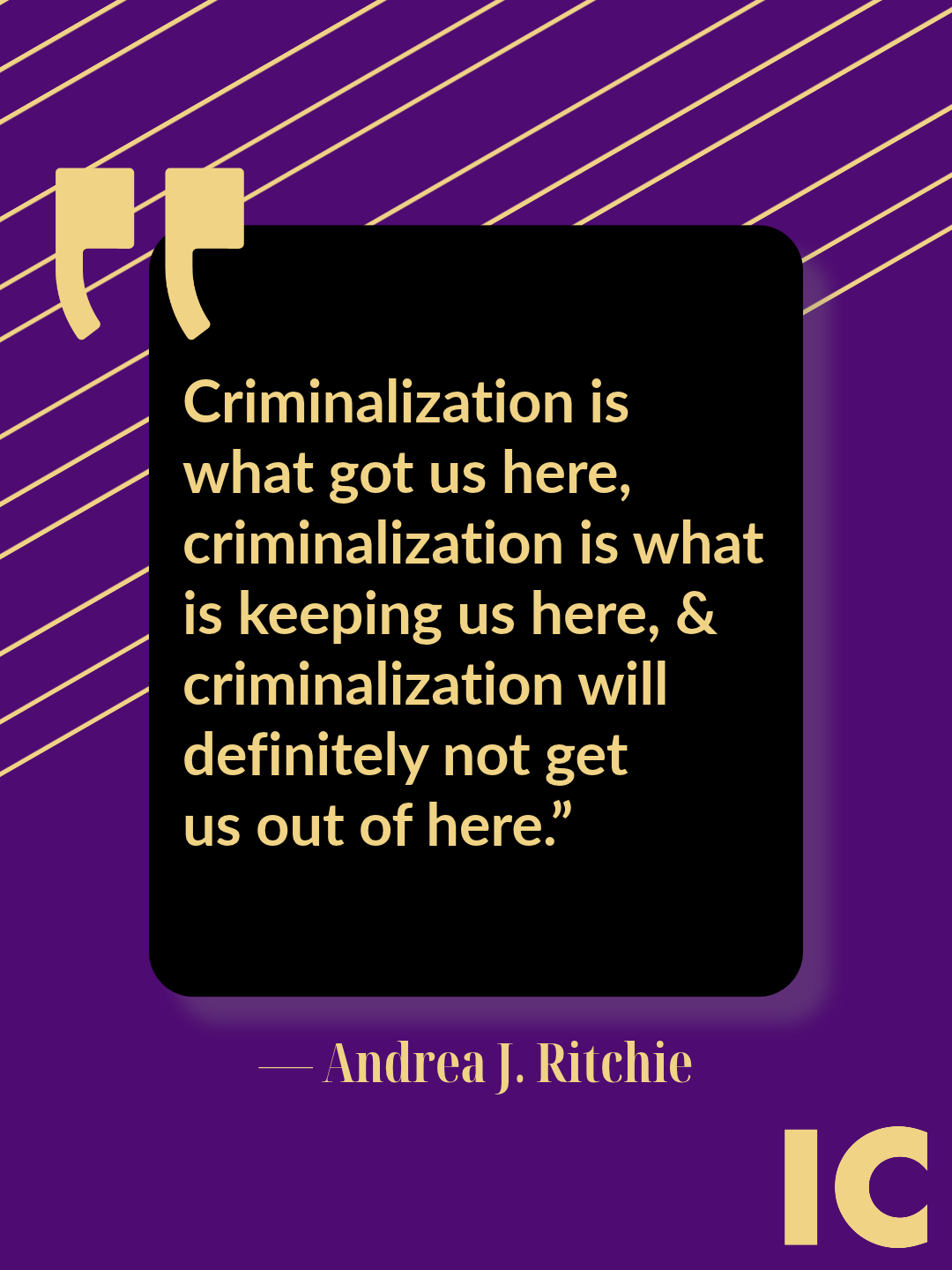
A commitment to criminalization acts as kryptonite to our capacity to effectively resist authoritarianism and fascism — and is manifesting on multiple fronts:
➡️ Establishment politicians are already trying to sell the same old recycled policy proposals ("body cameras," "oversight," etc.) that do nothing to prevent harm while further funding and legitimizing the institutions that enact it, as IC co-founder Andrea J. Ritchie wrote in The Nation last year.
It is essential that we insist on clarity and commitment from movements and politicians calling to Abolish ICE:
Abolishing ICE means completely dismantling and defunding ICE, DHS, CBP, and other agencies enforcing the U.S. border regime, and ensuring that their functions, personnel, policies, and practices are not simply absorbed by different federal, state, and local agencies.
While the regime maintains power to enforce the U.S. border regime, Congress has the power right now to completely turn off the tap of funds flowing to the agencies responsible — and it's on us to insist that they do so immediately. According to Detention Watch Network, "The most meaningful and immediate action that Congress can take is to claw back every remaining penny of the more than $240 billion that has been appropriated to ICE and Border Patrol through budget reconciliation since 2025 and zero out ICE funding in any upcoming fiscal year budget negotiations." The MAGA Murder Bill cut $1 trillion from health care and more than tripled funding to ICE to make it the most funded policing force in the history of the U.S. — demand Congress immediately claw back those funds and reinvest them into health care, SNAP, and other targeted programs!
-
✅ Check out and use these talking points developed by groups who have been organizing around policing, immigration enforcement, and abolition of ICE for decades when engaging with calls to abolish ICE.
-
✅ Find more ways to throw sand in the gears of the border enforcement regime in our regularly updated toolkit, Block It! Don't Build It. Don't Fill It. Don't Fuel It.
➡️ The ongoing exceptionalization of ICE as a "rogue" agency distinct from immigration enforcement and police forces across the country — is dangerous and can very well lead to pouring even more money and legitimacy into policing and police departments, as Andrea and Mariame discuss in a recent Death Panel episode.
While an encouraging number of newly elected officials claim abolitionist politics, pundits are already making the rounds citing junk science to call for more policing and bigger police departments — a significant number of which are already deputized by or collaborating with ICE. Unfortunately, these calls will find fertile ground among politicians across the political spectrum who built their careers on equating public safety with policing, building cop cities, and pouring money and legitimacy into police departments and surveillance equipment — unless we confront surveillance and policing practices that undergird and enable the spectacular violence of ICE:
-
✅ If you haven't already, check out Block & Build: But Make it Abolitionist, share the printable 'zine with your organization and movements, and find one way you can tap into or initiate a campaign to interrupt criminalization where you are!
➡️ Calls for an end to the regime's depravity, violence, and corruption which conflate individual and corporate accountability with criminal prosecutions and prison sentences.
Of course a reckoning is in order and consequences for the tremendous harm wreaked by the regime, its protagonists, and their foot soldiers over the past two years, both within and beyond U.S. borders, is long overdue. But as Andrea and Mariame have pointed out in the context of calls for police prosecutions in the case of Breonna Taylor and Derek Chauvin, centuries — or even just last two years — of experience with attempting to wield criminal punishment systems against cops and those whose power they are designed to uphold teaches us that investing time, resources, and political capital into prosecutions is unlikely to bear fruit. The chances that they will take place, succeed, or deliver any kind of meaningful consequence is extremely low — and certainly not within the next two years.
Most importantly, prosecutions will do nothing to address ongoing harms perpetrated by the U.S. government on millions of people in the U.S., at its borders, and around the world — prosecutions won't bring a single deported person back, reunite a single separated family, or offer compensation or repair for a single life, limb, child, job, home, relationship, or hour stolen by state violence, nor will they stop the next act of violence. Prosecutions are also not a prerequisite to taking immediate action toward those goals — indeed they are a barrier and a distraction from immediate and direct action, keeping us locked into a system we don’t control and that is not set up to deliver the justice it dangles in front of us like a perpetual mirage.
What a focus on criminal prosecutions will do is fuel the infrastructure and legitimacy of the logics, institutions, and practices that lay the foundation for authoritarianism and incipient fascism. While revenge fantasies are satisfying — we all have them! — we can’t build a society around them. That is literally what brought us here. And if we don’t break our addiction to punishment, we will find ourselves right back here and worse in short order.
✅ Instead, we can mobilize to:
defund and abolish DHS and the border regime it enforces, and remove its officials and agents from positions in which they have the power to do harm, ensuring they are not able to not just fade back into the military, police departments, jails, probation, parole, and prisons;
secure the immediate return of every person deported, prioritizing third country removals and canceling contracts with third countries to traffic in deportees, and the reunification of every family ripped apart;
offer compensation for every life, limb, job, home, car, and child lost, every sexual assault, disablement, miscarriage, and denial of abortion, every moment of separation, terror, heartbreak, and despair;
close all detention camps, jails, and prisons;
divest from the machinery of surveillance, AI, and data centers.
Our attention and resources in the coming weeks, months, and years are better directed toward more expansive demands such as these that bring us closer to true accountability, which offer and require so much more than prosecutions ever could, and that don't fuel the very systems we are fighting — and that move us toward building power to make and preserve systemic shifts that make consolidation of authoritarianism and fascism impossible in the future.
A reparations framework offers far broader possibilities for accountability and consequences for harm doers while focusing on repair, restitution, and healing for individuals and communities harmed, requiring acknowledgment, compensation, rehabilitation, and restitution. For instance, Chicago's reparations campaign, which Mariame co-led, ensured that survivors of police torture in Chicago received not only an acknowledgment and apology for the violence they experienced, but also compensation, access to education and employment, and individual and collective healing through the Chicago Torture Justice Center. Learn more from this toolkit from the Movement for Black Lives!
Most importantly, full reparations requires cessation and non-repetition of ongoing harm — an element that is frequently narrowly interpreted to mean changes to laws and policies, not structural relations of power, practices, and culture — or is swept under the rug completely when it comes to eliminating the capacity of individuals and corporations to repeat harm in the same or new forms, as has been the case for a number of Truth and Reconciliation processes. Not only does cessation and non-repetition mean abolition of laws, policies, and institutions that enabled and enacted harm, it means ensuring that the people who perpetrated it no longer have the power, capacities, and resources to do so in the future.
TL; DR: Our challenge in the wake of the midterms is to squarely confront the collective commitment to criminalization that made the last two years possible — and to not fall for it again.
We need to seize every opportunity to further expand our imaginations to envision and enact consequences without cages for those who have perpetrated the harm, to advance policies that offer immediate repair and restoration for those harmed, and to refuse, confront, and interrupt criminalization wherever it rears its head — including within our own hearts.
Join the consequences without cages challenge and stay tuned for more resources from IC in 2027!
While the "rule of law" delegates our collective power to the carceral state, a social contract is a set of collective agreements about how we want to be with each other — it can be built on surveillance, criminalization, policing, punishment, and exile, or it can be built on collective care, repair, and genuine accountability. If we do in fact want to build a society premised on love, one in which, in the words of the Critical Resistance - INCITE! Statement on Gender Based Violence and the Prison Industrial Complex, is "based on radical freedom, mutual accountability, and passionate reciprocity," in which "safety and security will not be premised on violence or the threat of violence; it will be based on a collective commitment to guaranteeing the survival and care of all peoples," then criminalization is the root we must pull on with all of our might.
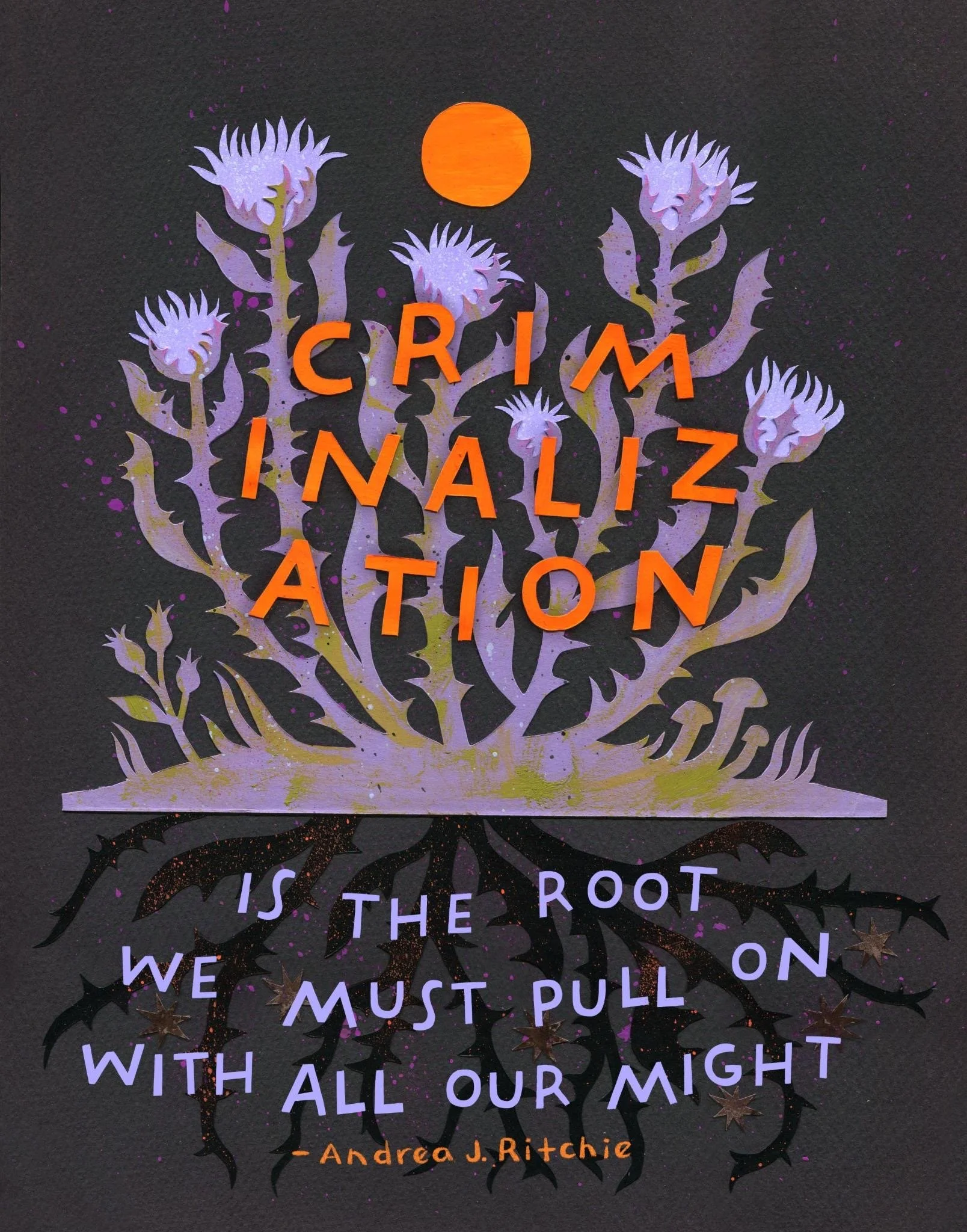
Image from Olly Costello's A World to Win: Fighting for Us All Amid the Rise of Fascism 2027 Calendar — pre-order before they run out!
Resisting Anti-Trans, Anti-Abortion Measures
➡️ Republicans and their allies spent an estimated $183 million on anti-trans ads during the midterm election cycle, and over $500 million (half a billion with a "b") over the past two years, while many of their opponents remained silent or worse yet, joined in on anti-trans rhetoric. At the same time, Right-wing "media" outlets are increasingly publishing hit pieces targeting organizations, networks, and providers that are ensuring access to gender-affirming care for trans youth, deploying tactics long used to infiltrate and target abortion providers.
➡️ The outcome was predictable, and in some instances devastating: four states — Nebraska, Arizona, Washington and Colorado — passed ballot measures banning trans girls from competing in girls' sports. In Washington state the measure requires sex "verification" for all students on girls' sports teams, while in Arizona the measure also bans trans people attending public schools from using bathrooms and locker rooms consistent with their gender. Colorado also passed a ban on gender-affirming care for trans youth, while Idaho rejected a ballot measure that would have codified the right to reproductive freedom and privacy in the state constitution.
➡️ There were also some critical wins in the face of the onslaught of transphobic rhetoric and efforts to further limit access to reproductive care:
-
🎊 Missouri rejected a ballot measure that would essentially ban abortion and gender-affirming care for trans youth after a campaign bringing together advocates for sexual, gender, and reproductive autonomy led by PROMO.
🎊 Washington state rejected a ballot measure requiring schools to provide parents with students' private health information thanks to the efforts of No Hate in WA State
🎊 Nevada passed a measure codifying a state constitutional right to an abortion "before fetal viability."
-
➡️ A critical lesson to be drawn from these struggles and outcomes is the importance of deep community engagement and joining forces across movements for abortion access and gender-affirming care under a common banner of protecting bodily autonomy and sexual, gender, and reproductive self-determination against targeting using common tactics, at times against overlapping communities of care providers and recipients.
-
✅ If you are a health care provider or advocate committed to interrupting criminalization of care and ensuring access to reproductive and gender-affirming care, join the Beyond Do No Harm Network!
Stop the Deadly Merger, Keep Up Action to Stop Israeli Genocide!
➡️ Despite public statements by the regime acknowledging that public opinion has shifted against continued U.S. bankrolling of genocide, and suggesting that cuts to military aid to Israel might be forthcoming, arms sales and efforts to merge U.S. and Israeli military operations through the Deadly Merger continue apace.
➡️ Meanwhile,
Widespread flooding in Gaza has devastated precarious tent cities as shelter becomes harder to come by following the occupation's closing of the Rafah border. The "yellow line" marking the border of the Israeli occupation of Gaza continues to move westward and has become "a kill zone," according to a recent report from the Office of the United Nations High Commissioner for Human Rights (OHCHR). Currently, Israeli forces occupy 53% of Gaza and have expressed their intent to expand to 70% of the area.
Settler violence backed by the IOF continues to disrupt the annual olive harvest in the West Bank.
The Israeli military's ten day siege of Hebron, the largest city in the West Bank, displaced over 5,000 Palestinians and led to 120 arrests and destruction of 13 businesses, causing economic losses well over the equivalent of $3 million in a city responsible for 40% of Palestinian industrial output.
-
✅ When we fight for divestment, we win! Learn more and get inspired:
🎊 Providence, Rhode Island became the largest city in the country to vote (by 75%) for requiring the city to sell investments in Israel and companies knowingly enabling the genocide.
🎊 On November 1st, Palm Beach County, Florida organizers were able to successfully block reinvestment of $67.5 million in maturing Israel Bonds in the municipality that is the worlds largest investor in the bonds — holding a total of $1 billion.
🎊 In Cambridge, Massachusetts, the city council voted for a resolution divesting the city's pension and retirement funds from companies profiting from genocide against Palestinians, including defense contractors like Palantir, Elbit Systems, Lockheed Martin, GE Aerospace, and Boeing.
🎊 In one of the largest coordinated port actions in history, dockworkers in 22 countries around the world declared that "Dockworkers Do Not Work for War" and launched a coordinated strike to halt the shipment of weapons to Israel through international ports.
✅ Support groups working to stop the profits of genocide, including:
Break the Chain in the NYC-NJ area
People's Arms Embargo in Oakland, CA
Mask Off Maersk across the country
Read about the work of organizers in Houston to disrupt the city's International Maritime Conference where many shipping and logistics companies complicit in the genocide are meeting.
✅ Learn about organizing your union against genocide with Break the Chain's Labor Organizing Toolkit.
✅ See what pensions funds in your state are invested in Palantir.
✅ November 11-12: Register and join the Palestinian Feminist Collective on November 11-12 for Palestinian Women Journalists Speak Up: “Testimonies from within a Genocide” — and learn more about their report, A Predatory State: Israeli Systemic and Sexualized and Gender Violence Against Palestinians, at one of their upcoming events.
✅ Donate to the Sameer Project.
Free Support
➡️ Feeling scared? Overwhelmed? The Liberation Line is there to support you! The Liberation Line provides free mental health support calls to organizers and activists, offering support, listening, resources, processing, debriefing or strategizing. These are confidential, non-crisis, non-therapy phone calls facilitated by a trusted volunteer with experience in offering mental health support and who aligns with Palestinian and collective liberation. The Liberation Line is open to any organizer or activist involved in social or political change, who may be impacted by police or state brutality, counter-protestor violence, racism, oppression, or is experiencing conflict, stress, burnout or trauma related to their community organizing or activism.
➡️ A reminder that Interrupting Criminalization also offers a number of free help desks:

Abolition Media Office Hours — for journalists, communicators, and media makers who want to challenge "copaganda,” shift the narrative about Palestine, crime, community safety, and other subjects, or directly support incarcerated people in telling their own stories; for organizers looking for help on how to build relationships with journalists or hone in on messaging their campaigns.
Transformative Justice Help Desk— for groups and individuals who are working on projects and community-wide interventions to respond to, transform, and interrupt harm and violence without using the police and other carceral systems, and are looking for support or thought partnership.
Resisting Criminalization Help Desk — The Resisting Criminalization Help Desk is on a temporary break through the end of the year, but please reach out to info@interruptingcriminalization.org if you are in urgent need of time-sensitive thought partnership around a campaign or intervention to interrupt criminalization.
Beyond Do No Harm Health Care Strategy Consult — health care workers committed to preventing and resisting harm in health care, or looking for a thought partner on practical strategies for organizing to interrupt criminalization in health care environments.
Subscribe
Want to get “This Month in Criminalization” delivered to your email inbox?