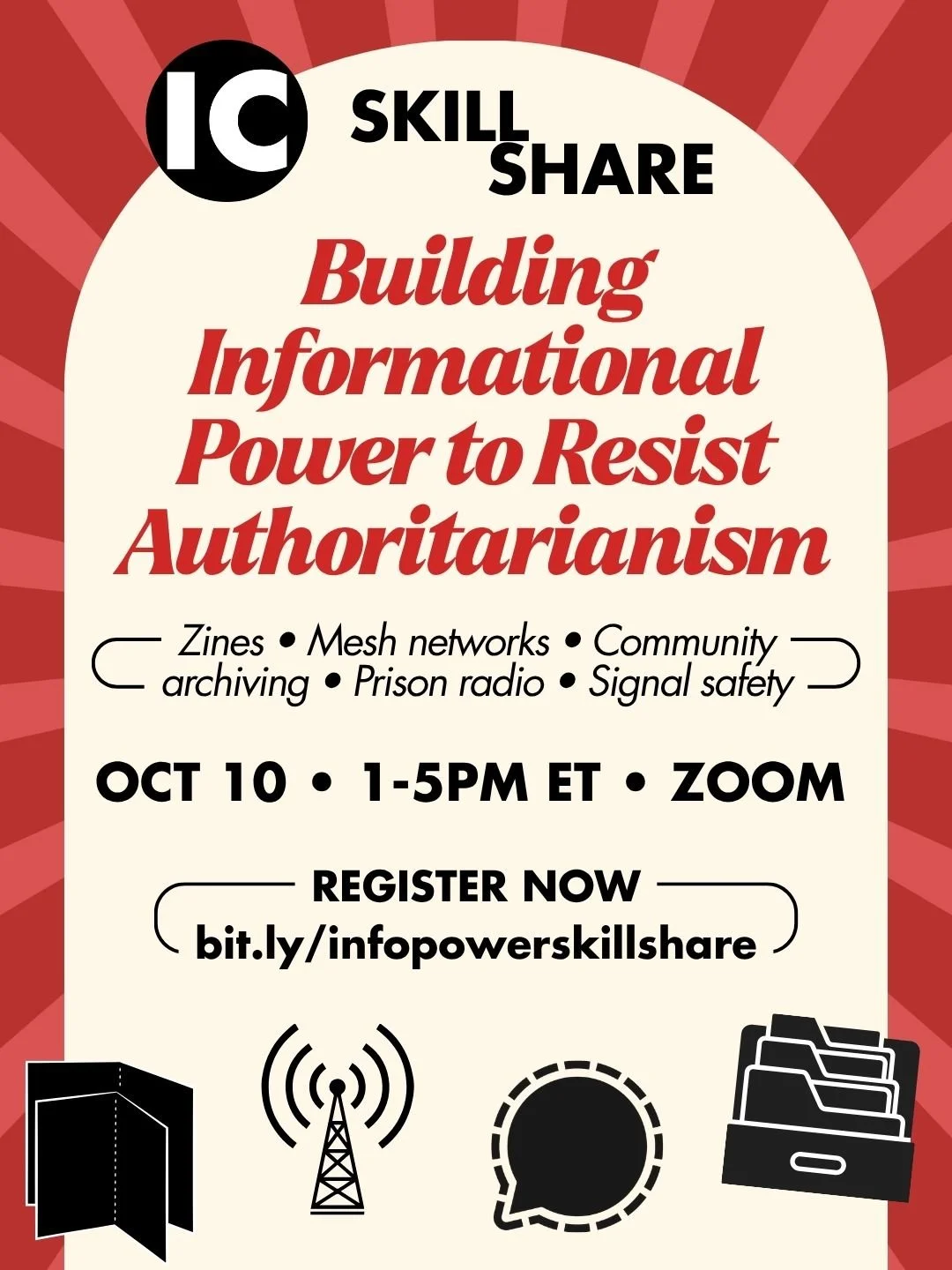
Building Informational Power to Resist Authoritarianism: A Skill Share
'Zines! Mesh networks! Community archiving! Prison radio! Signal safety!
October 10
1 to 5 PM ET PM on Zoom
Join Interrupting Criminalization on October 10th for a half-day interactive online skill share to learn about to build community controlled communication networks in the context of rising authoritarianism!
Setting the scene
Social media is a surveillance hellscape, the internet is an AI nightmare, and even our Signal threads are insecure. Yet we know that in the context of rising criminalization and authoritarianism, communities of resistance need information we can trust. We believe a key part of that is building informational power by creating infrastructure we can trust: from phone trees to mesh communications, 'zine libraries, alternative archives, community-run media outlets, and the trusted relationships that hold it all together.
Informational power establishes sustained, proactive community control over the facts and information that we need in order to struggle and survive, and that inform how we make sense of the world together and the actions we take to shape our futures.
About this event
Interrupting Criminalization's 2025 report, Shaping Reality: Building Informational Power to Resist Authoritarianism calls on organizers and funders to pursue control over informational infrastructure as a key part of movement strategy. In the report, we discuss how "messages alone don't change minds. Neither do facts. Where facts and messages are most effective is in the context of relationships." In this half-day session on Zoom (with plenty of breaks), we'll explore the challenges and opportunities for community-controlled informational infrastructure, and break out into skill sharing groups based on interest.
Who is this event for?
This event is for activists, journalists, movement media makers, and organizers interested in informational infrastructure that we control! It is organized by Interrupting Criminalization's co-principal Andrea Ritchie and Abolition Journalism Fellow, Lewis Raven Wallace, with guest presenters including Nasir Anthony Montalvo of {B/qKC}, an archive of Black queer Kansas City history; Sarah Grant of Visceral Systems and Radical Networks; Luz Canela of Familia: Trans Queer Liberation Movement (FTQLM) and trans activist Daniel Trujillo; and more!
Breakout session descriptions
📂 Archiving sans Big Tech — with Nasir Anthony Montalvo
With the Internet increasingly under threat of intense consolidation and control under just a few major players, issues of censorship, surveillance and environmental harm are being raised simultaneously. For those of us who steward precious digital artifacts, we must remain vigilant: asking ourselves who benefits and who stands most at-risk from our data.
In this session, {B/qKC}, an archive of Black queer Kansas City history, presents a suite of decentralized and open-source technologies it has used to keep sensitive and powerful artifacts in its community hands, and their hands only.
-
Nasir Anthony Montalvo (b. 1999) is an experimental memory worker. Montalvo’s work challenges the erasure of Black and queer people from our historical record through archival study, obsolete and
emergent technology, popular education, and the written word.Montalvo’s art and archival research has been exhibited locally and nationally, published in Syllabus, Sixty Inches From Center, The Advocate, and KC Studio, and collected by the Harvard Radcliffe Institute. Their work is referenced in curricula at Johns Hopkins University, Columbia University and Pomona College. Montalvo is founder of {B/qKC}: a community archive of Black queer midwestern history, and has been awarded fellowships with The Opportunity Agenda, Diaspora Solidarities Lab, and Gray Area in addition to their 2024-2026 studio residency at Charlotte Street.
Montalvo is queer, Afro-Boricua, and from Kissimmee, Florida. They received their BS in Business & Technology from Stevens Institute of Technology.
📟 Permissionless Networks with Meshtastic — with Sarah Grant
Mesh networks are a form of decentralized communication infrastructure that route messages peer-to-peer rather than through centralized servers or cell towers. This session opens with an introduction to the concept, surveys different kinds of mesh networks, and then focuses on Meshtastic, a long-range LoRa-based protocol that runs on small, low-power devices.
We will discuss scenarios where this kind of network becomes useful, from disaster response to community infrastructure to off-grid coordination. Participants are encouraged to install the Meshtastic app on their phones to explore the interface together.
-
Sarah Grant is an American media artist and educator based in Berlin. Her practice engages with the electromagnetic spectrum and telecommunication networks as artistic material, social habitat, and political landscape. With a focus on radioart and computer networking, she researches and develops artworks as educational tools and workshops that demystify computer networking and radio technology. She also runs Visceral Systems, a creative technology studio, and organizes the Radical Networks conference in New York and Berlin, a community event and arts festival for social justice activations, critical investigations, and creative experiments in telecommunications.
🎙 Inside/Outside Prison Journalism and Radio — with Lewis Raven Wallace and inside guests
No one is better situated to analyze and respond to rising censorship and authoritarianism than people who are already living in U.S. state and federal prisons. Interrupting Criminalization's Abolition Journalism Cohort has worked since 2022 to develop a network of incarcerated and non-incarcerated journalists and media makers who collaborate on projects in the context of the intense surveillance and punitive environment of prison. Members of the group collectively and individually have worked on news articles, columns, podcasts, radio broadcasts, an online TedX-style talk, and now are creating a 'zine.
While the limitations of prison make independently-controlled communications next to impossible, prison journalists are constantly finding work-arounds, and outside collaborators can help support this through dedicated and careful work. This session is designed as a skillshare for anyone who is working with people on the inside, or wants to be, on how to collaborate effectively to build the human infrastructure required for inside/outside solidarity. We will also share nuts and bolts: how do you record, edit, get a prison story on the radio, do a public zoom, make a 'zine together with people who are behind bars?
-
Lewis Raven Wallace (they/ze/he) is the Abolition Journalism Fellow at Interrupting Criminalization and the author of The View from Somewhere: Undoing the Myth of Journalistic Objectivity and Radical Unlearning: The Art and Science of Making Change from Within as well as the forthcoming book from Beacon Press, Journalism as Resistance:How to Fight Authoritarianism with Movement Media and Grassroots Reporting, out in 2027.
Lewis, a facilitator, organizer, and popular educator, previously worked in public radio, and is a long-time activist engaged in prison abolition, racial justice, and queer and trans liberation. Lewis is white and transgender, and was born and raised in the Midwest with deep roots in the South.
📝 Making Movement Zines: Skill Sharing the Process of Developing “No ICE or Transphobia on Campus” — with Luz Canela and Daniel Trujillo
With the rise of misinformation, authoritarian propaganda, and heightened attacks on journalism and storytellers across the globe, we reclaim the ways we tell stories through zines, comics, and other avenues to share information.
Familia: Trans Queer Liberation Movement (FTQLM) has led a community-created zine called No ICE or Transphobia on Campus with two trans/immigrant youth to tell a story about solidarity and organizing. In this breakout, we share our process and how you can create your own or collaborate with us in sharing unique stories like this one. Templates will be available!
During the breakout sessions, Luz, alongside Daniel, will feature an editorial project they led, titled Barrio Scholars: No ICE or Transphobia on Campus. The piece highlights real-world events and youth leadership through the story of Daniel Trujillo, a trans teenager who mobilized his peers to establish campus policy during intense ICE activity. This narrative serves as a vital beacon for visionary change. During this section, they will both share their process and discuss opportunities for collaboration to circulate the story broadly or develop stories with a similar intention.
-
Luz Canela (they/them) is a Mexican Latine, non-binary, and queer movement organizer with a background in graphic design and strategic communication. Their work is deeply rooted in bridging the intersections of TGNC, immigrant, and BIPOC communities through culturally strategic communications.
Deepening their commitment to abolitionist organizing and transformative justice, Luz serves as the Communications Director at Familia: Trans Queer Liberation Movement (Familia: TQLM). In their free time they care for @tochtli.bby and test narratives around my block and local networks.
-
Daniel Trujillo (he/him) is a nineteen-year-old Chicano soon-to-be college student from Tucson, Arizona, who is currently living abroad. A dedicated trans activist best known as one of the creators and four organizers of Trans Prom, Daniel has been advocating for trans rights for most of his life. In fact, he first spoke at the Arizona State Capitol when he was just nine years old.
Daniel’s activism has taken many forms, including being featured in the short film Daniel Really Suits You, which has been selected for this year’s Sundance Film Festival and Tribeca Film Festival. He was also featured in the ACLU’s Freedom To Be campaign, which highlights transgender people and their families across the country finding joy and community.
Committed to uplifting the voices of trans youth, Daniel has spoken regularly at the Arizona State Capitol and on panels addressing issues that impact transgender people. He also leads a youth space for the Gender Liberation Movement, where he and other young people connect and organize.
When he’s not working to change the world, you can find Daniel drawing, building LEGOs, or playing his guitar.
💬 Safer Signal Chats — facilitation TBA